Planning to capture stunning aerial footage in Bangladesh? Whether you’re producing a documentary, commercial advertisement, real estate showcase, or travel content, understanding the permit requirements is crucial for a successful shoot. This comprehensive guide provides everything you need to know about drone filming in Bangladesh, drawn from our extensive field experience working with international production crews and navigating CAAB regulations.
Let’s dive into the exact steps you need to take for legal drone filming in Bangladesh.
What you will learn from this article
- Understanding Drone Categories
- How to get approved by the government
- 9-Step Permit Process
- Regional droen regulation
- Cost Breakdown
- Frequently Asked Questions
Why Drone Permits Matter in Bangladesh: The Real Cost of Non-Compliance
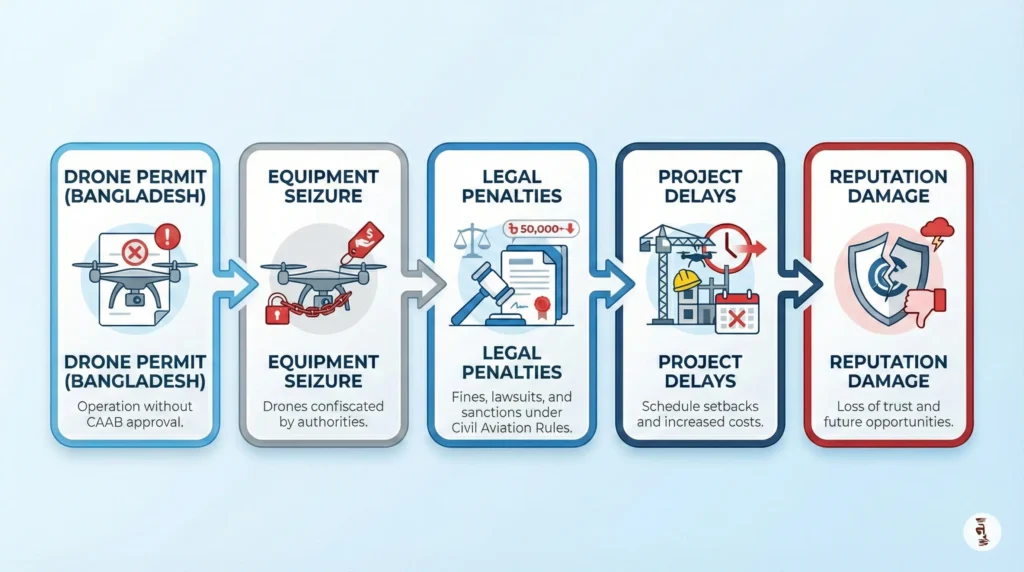
Flying without the correct permit can ground your shoot, lead to equipment seizure, legal fines, and damage your professional reputation. Non-compliance isn’t worth the risk.
Legal Penalties: Equipment seizure, prosecution under the Civil Aviation Authority of Bangladesh (CAAB) Act of 2017 and the Penal Code of 1860, and denial of future filming permits.
Financial Impact: Beyond legal fines, expect project delays costing thousands of dollars per day, unusable footage, and damaged reputation with clients and local authorities.
Security Concerns: Bangladesh’s regulatory framework ties drone operations directly to national security protocols. Unauthorized flights near military installations, government buildings, or border areas trigger security alerts and can result in detention for questioning.
Real-World Context: In our decade of facilitating drone shoots across Bangladesh, we’ve witnessed productions grounded mid-project due to incomplete paperwork. One international crew faced a three-week delay because of that.
Learn from comprehensive resources like DJI’s global drone regulations guide to understand international best practices, then apply Bangladesh-specific requirements.
The message is clear: compliance isn’t optional—it’s the foundation of successful aerial filming in Bangladesh.
Understanding Bangladesh’s Drone Categories for Filming
Drones are classified into three categories: Toy (<250g, no camera), General-use (most filming drones), and Cargo/Passenger. If your drone has a camera, you need full CAAB clearance.
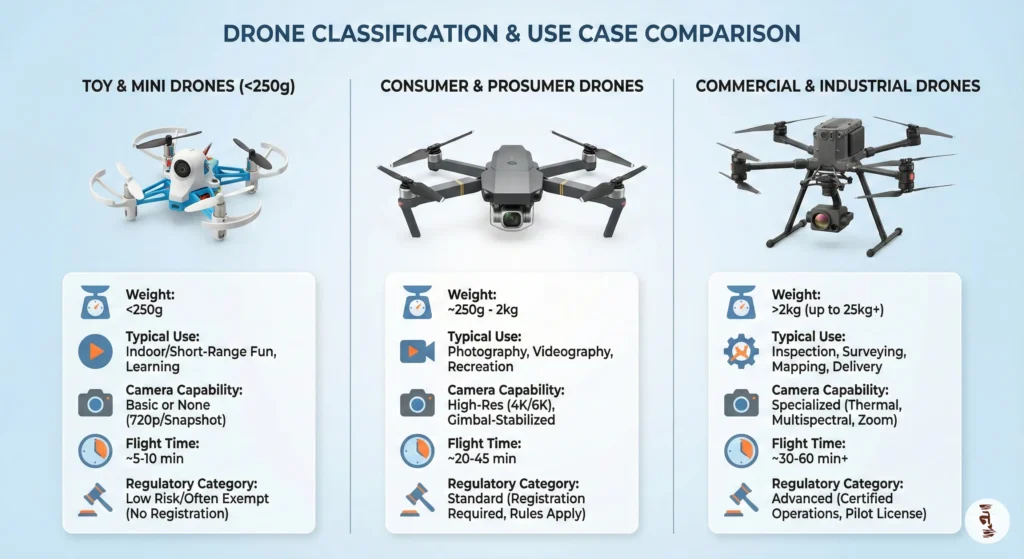
Before applying for any permits for drone filming in Bangladesh, you must correctly classify your drone. The draft Drone Regulations 2024 categorize drones into three main types, each with distinct requirements:
Toy Drones (Recreational Use)
- Weight: Under 250 grams
- Capabilities: No audio or video recording equipment
- Height Limit: Can be flown up to 100 metres without prior permission in green zones
- Permit Required: Minimal (under draft 2024 regulations)
Important Note: While the 2024 draft suggests relaxed rules for toy drones, current CAAB practice requires clearance for any camera-equipped device used for filming purposes, regardless of weight. Always declare your equipment when planning commercial shoots.
General-Use Drones (Commercial Filming)
- Weight: Over 250 grams OR equipped with camera /microphone
- Typical Uses: Aerial filming, surveying, real estate, documentaries, advertising
- Permit Required: Full CAAB clearance mandatory
- Operator Requirements: Remote Pilot Certificate, age 18+
This is the category most filmmakers fall into when planning drone filming in Bangladesh. If you’re reading this guide, you’re likely operating in this space. For international standards on commercial drone operations, refer
to the International Civil Aviation Organization (ICAO) drone guidelines
Cargo/Passenger Drones
- Purpose: Transporting goods or people
- Status in Bangladesh: Emerging use-case, not yet common
- Requirements: High-level specialized approval
Step-by-Step: How to Secure Your Drone Filming Permit in Bangladesh
Successfully obtaining permits for drone filming in Bangladesh requires careful planning and understanding of CAAB requirements. If you’re also interested in general film production permits in Bangladesh, check our comprehensive guide.
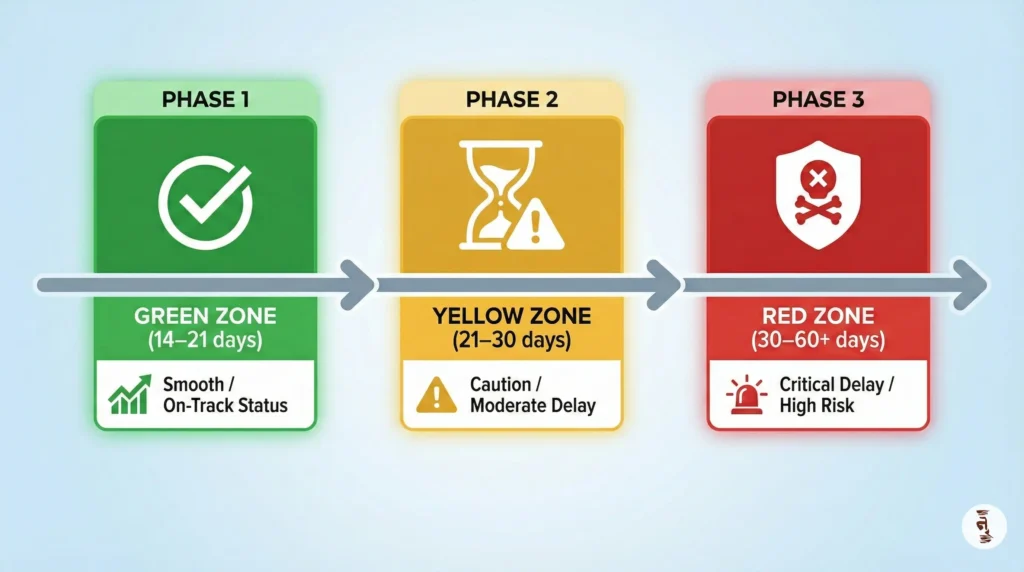
Timeline Overview: Start Early
The permit process involves 9 steps:
- Green Zone Shoots: 14-21 business days
- Yellow Zone Shoots: 21-30 business days
- Red Zone Shoots: 30-45 business days (may extend to 60+ days)
Critical Rule: Authorizations must be submitted 45 days in advance to CAAB. While some green zone permits process faster, always budget for the maximum timeline to avoid delays.
Step 1: Register Your Drone with CAAB
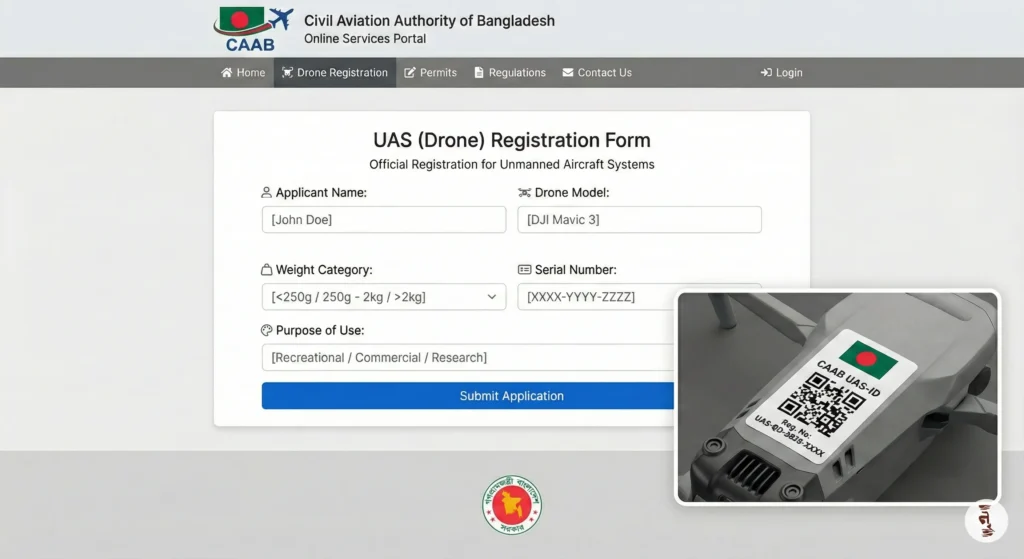
What You Need:
- Owner details (full name, address, contact information)
- Drone specifications (make, model, serial number)
- Import documentation (if applicable)
- High-resolution photos of the drone
Process:
- Visit the CAAB online portal at ops.caab.gov.bd
- Submit Form CAAB-UAS-REG-01 (Drone Registration)
- Pay registration fee (contact CAAB for current rates)
- Await unique UAS-ID assignment
- Physically affix UAS-ID to the drone body
Pro Tip: Photograph your drone with the UAS-ID clearly visible. You’ll need this documentation for every flight application.
Obtain Operator Certification
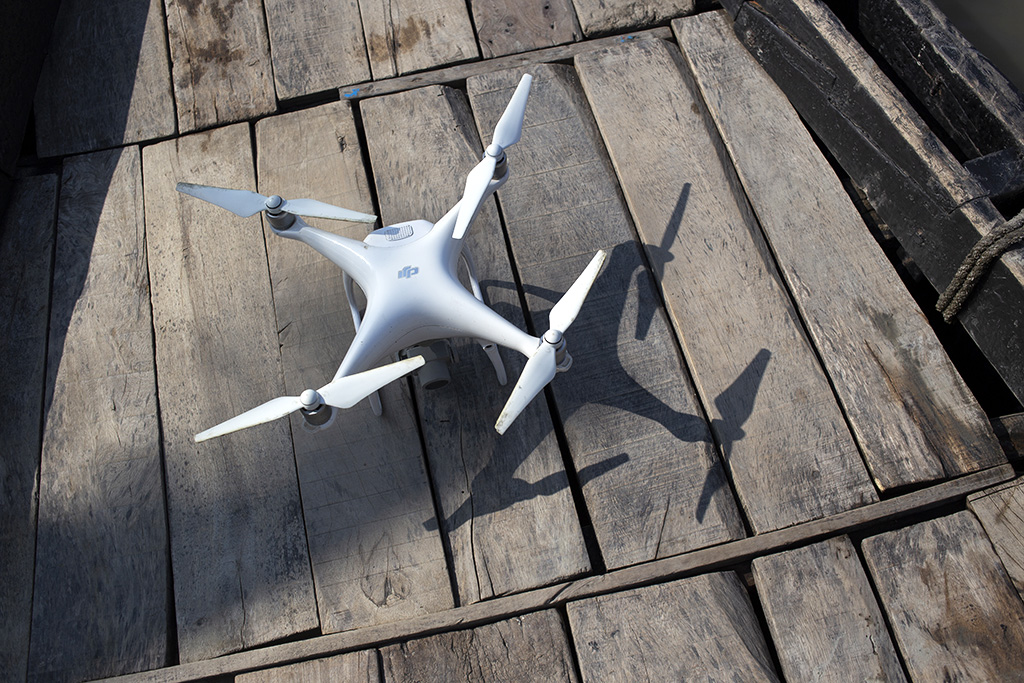
Operator Requirements:
- Minimum age: 18 years or older
- Remote Pilot Certificate from CAAB or ICAO member state
- Class 3 medical certification (for certain operations)
- Valid insurance policy
Certificate of Competency Application:
- Complete pilot training through CAAB – approved program
- Pass the written examination covering aviation regulations, meteorology, and safety procedures
- Demonstrate practical flying competency
- Submit the application with training certificates and ID documents
International Operators: If you hold a pilot license from another ICAO member state, you must validate it with CAAB before operating in Bangladesh.
Step 3: Secure Import Clearance (For Foreign-Owned Equipment)
Required Clearances:
- Ministry of Defence (MOD): No-Objection Certificate (NOC) for import
- Ministry of Home Affairs: Security clearance
- Customs Documentation: ATA Carnet or temporary import permit
Import Timeline: 2-4 weeks. Begin this process immediately after confirming your shoot dates.
Common Mistake to Avoid: Some crews attempt to bring drones through customs without pre-clearance, assuming equipment carnets suffice. In Bangladesh, MOD approval is mandatory regardless of carnet status.
Customs will confiscate undeclared drones. For detailed guidance, see our drone import clearance guide for Bangladesh
Step 4: Apply for Flight Clearance
Application Components: For each shooting location and date, submit:
- Flight Plan Details:
- Exact GPS coordinates
- Flight date and time window
- Maximum altitude (typically capped at 120 meters / 400 feet)
- Flight duration and pattern
- Production Information:
- Shooting purpose and project description
- Client information
- Crew list with roles and ID copies
- Production company registration documents
- Security Clearances:
- MOD No-Objection Certificate
- National Security Intelligence (NSI) clearance
- Local police notification letter
- Technical Documentation:
- Drone specifications and capabilities
- Insurance certificate (third-party liability minimum)
- Operator licenses for all pilots
- Emergency contingency plan
Review Process: Your application undergoes multi-agency review:
- CAAB Flight Standards Division
- Air Defence Operations Centre
- Local police jurisdiction
- Additional agencies based on location sensitivity
Step 5: Understand and Navigate Airspace Zones
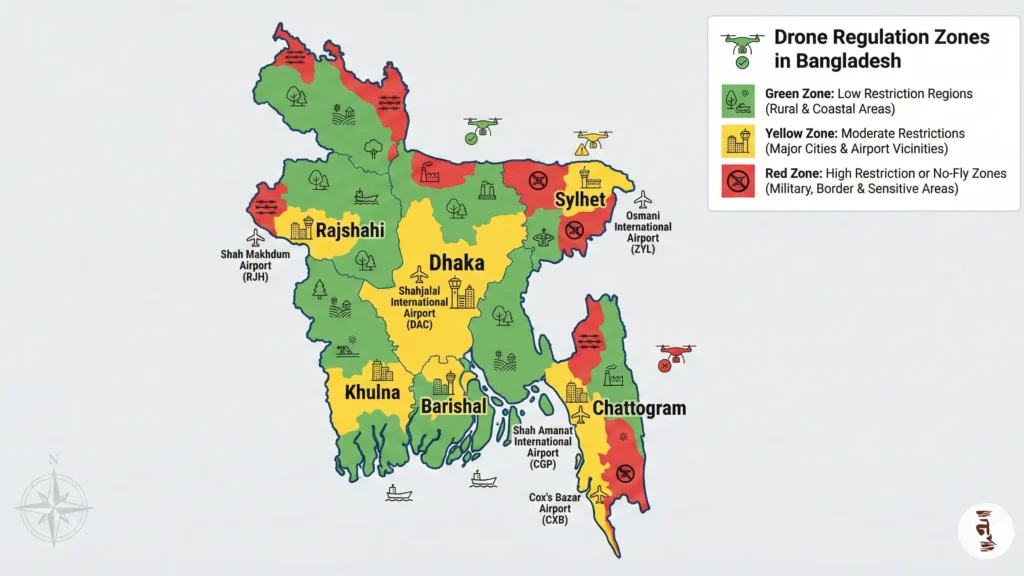
Bangladesh’s airspace is divided into three distinct zones, each with different clearance requirements:
Green Zone (Low-Risk Areas)
Characteristics:
- Open fields away from populated areas
- Agricultural land
- Coastal areas (excluding border regions)
- Areas beyond 10km from airports
Examples: Cox’s Bazar beach areas (non-border sections), Sylhet tea gardens, rural landscapes
- Clearance Level: Standard CAAB approval
- Approval Time: 14-21 days
- Best For: Travel vlogs, nature documentaries, real estate in rural areas
Yellow Zone (Moderate-Risk Areas)
Characteristics:
- Areas near airports, densely populated regions, and public gatherings
- Urban centers
- Event locations
- Infrastructure projects
Examples: Dhaka city shoots, Chattogram port areas (non-military), major highways
- Clearance Level: CAAB + additional stakeholder approval
- Approval Time: 21-30 days
Special Requirements:
- Maintain 18.5 kilometers (10 miles) distance from airports without authorization
- Coordinate with local law enforcement
- May require public liability insurance increase
Red Zone (High-Security Areas)
Characteristics:
- Military bases, sensitive government installations, and border areas
- Critical infrastructure (power plants, water treatment facilities)
- Diplomatic zones
- Areas within two kilometers of VVIP events
Examples: Cantonment areas, border regions with India and Myanmar, Parliament complex, Presidential residences
- Clearance Level: High-level authorization from multiple security agencies
- Approval Time: 30-60+ days (no guarantee)
Reality Check: Many red zone locations remain completely off-limits for civilian drone operations. Plan alternative angles or ground-based filming.
Pro Strategy: Always consult CAAB’s interactive airspace map during location scouting. Download offline maps as backup. If the interactive portal is unavailable. contact CAAB’s focal point directly at dfsr@caab.gov.bd or +880 2 8901406. Understanding airspace restrictions is critical for successful drone filming in Bangladesh.
Step 6: Secure Insurance Coverage
Mandatory Requirements:
- Liability insurance covering risks of injury or damage to public and/or property is mandatory for all types of drone operations
- Minimum coverage amounts vary by drone weight and project scope
- Policy must be issued or validated by Bangladesh-recognized insurer
Insurance Coverage Should Include:
- Third-party bodily injury
- Property damage
- Equipment damage/loss
- Professional indemnity (for commercial work)
Where to Obtain:
- International production insurance extended to Bangladesh
- Local insurance providers (coordinate through your fixer or production service company)
Cost Range: $500-$2,000+ per production depending on coverage limits and duration
Step 7: Implement Operational Safety Measures
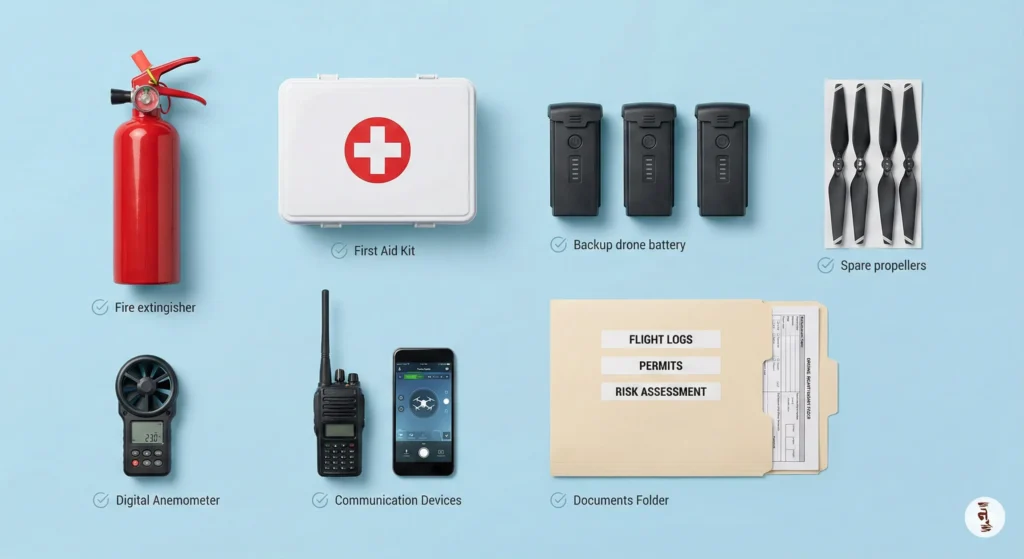
Technical Safeguards:
- Geofencing: Program altitude limits and no-fly boundaries
- Return-to-Home (RTH): Configure automatic return protocols
- Battery Management: Never operate below 30% battery
- Weather Monitoring: Operations may only be conducted during daylight hours and in Visual Meteorological Conditions (VMC)
Crew Requirements:
- Remote Pilot-in-Command (PIC) with full attention on drone
- Visual Observer (VO) monitoring airspace and ground hazards
- Safety Officer for crowd management (when applicable)
Distance Requirements:
- Maintain 300 meters (1000 feet) from buildings, vehicles, people, animals not involved in operations
- Keep 9 kilometers (5 miles) distance from built-up areas (without specific clearance)
Equipment Checklist:
- Fire extinguisher (mandatory on-site)
- First aid kit
- Communication devices for crew coordination
- Backup batteries and propellers
- Weather monitoring tools
Step 8: On-Location Protocols and Documentation
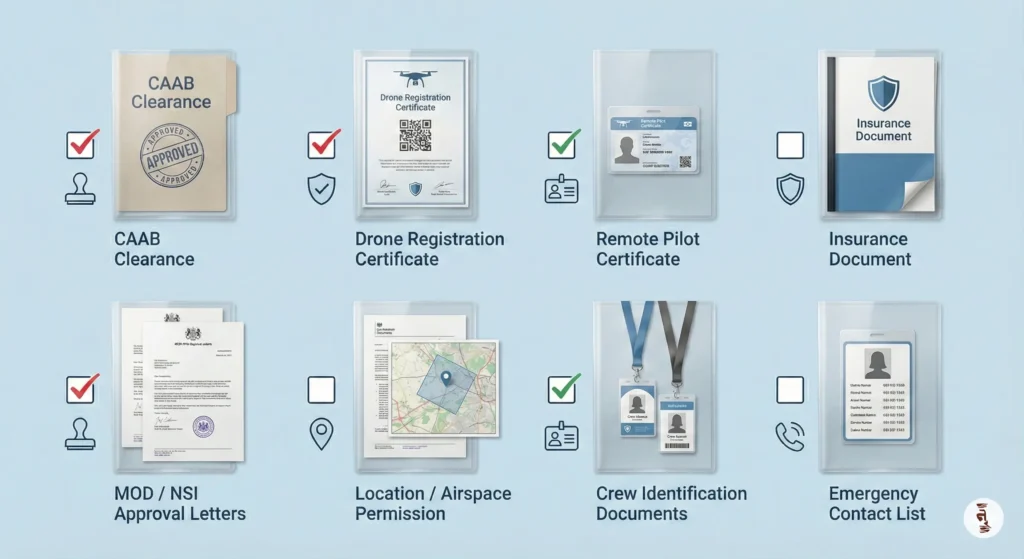
Required On-Site Documents (Print and Digital):
- CAAB flight clearance letter
- Drone registration certificate with visible UAS-ID
- Operator Remote Pilot Certificate
- Insurance policy documents
- MOD/NSI clearance letters
- Location permissions (if private property)
- Crew identification documents
- Emergency contact list
During Operations:
- Maintain detailed flight log with takeoff/landing times
- Record GPS coordinates for each flight
- Document weather conditions
- Note any incidents or anomalies
- Keep video metadata intact
Inspection Protocol: CAAB officials or local police may conduct on-site inspections without notice. Cooperate fully, present all documents, and demonstrate safe operating procedures. Resistance or missing documentation can result in immediate operation shutdown.
Daily Pre-Flight Checklist:
- Visual aircraft inspection
- Battery voltage check
- GPS signal acquisition
- Compass calibration
- Control link verification
- Weather assessment
- Airspace double-check
- Crew briefing
Step 9: Post-Flight Compliance and Data Retention
Flight Log Requirements:
- Retain all flight logs for minimum 90 days post-operation
- Include: date, time, location, duration, altitude, operator name, purpose
- Store both digital and physical copies
Footage Handling:
- Maintain chain of custody for all aerial footage
- For sensitive location shoots, expect potential export clearance review
- Client deliverables may require CAAB content review (rare, but possible for certain government/infrastructure projects)
Incident Reporting: If you experience any of the following, immediate CAAB reporting is mandatory:
- Near-miss with manned aircraft
- Injury to any person
- Property damage
- Flyaway/loss of control
- Equipment malfunction causing emergency landing
- Unauthorized airspace penetration
Failure to report incidents can result in license suspension and future permit denials.
Practical Filming Scenarios: Tailored Strategies for Drone Filming in Bangladesh
Different shoot types require different approaches. Travel/tourism works best in green zones (Cox’s Bazar), real estate needs yellow zone permits in cities, VVIP events trigger red zone restrictions, and infrastructure shoots require heavy-duty equipment clearances.
Understanding how to apply permit requirements to your specific project type ensures smoother drone filming in Bangladesh operations.
Travel Documentary & Tourism Content
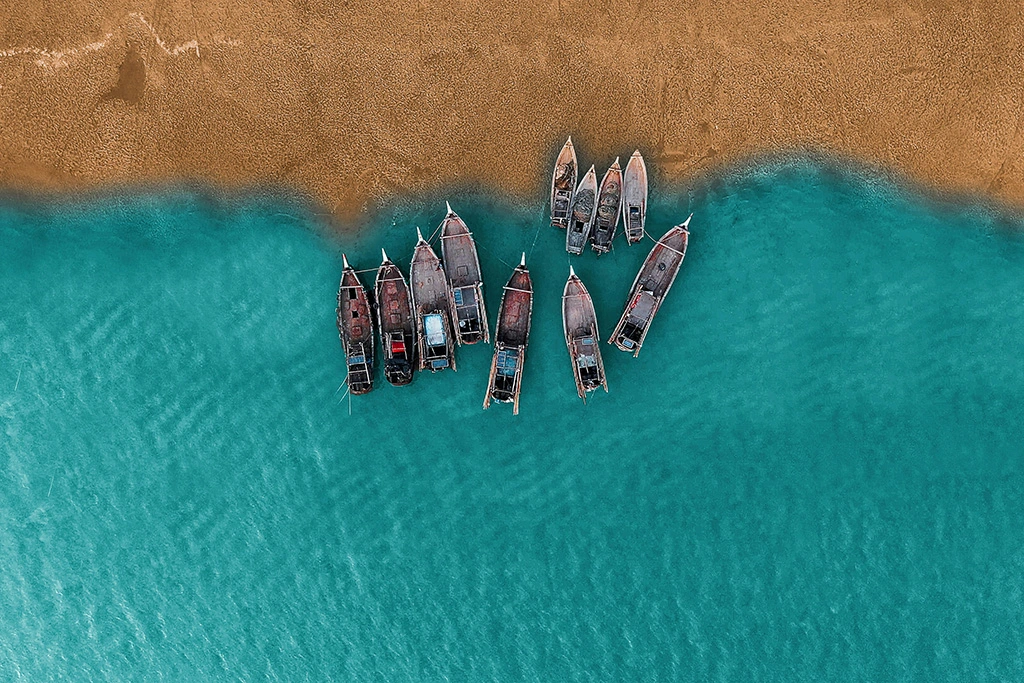
Ideal Locations:
- Cox’s Bazar: world’s longest beach, but stay away from Myanmar border areas (red zone)
- Sundarbans: mangrove forests (requires forest department clearance)
- Sylhet tea estates: rolling hills, green zone classification
Timeline Strategy: Apply 30 days out even for green zones. Tourism shoots often involve multiple locations, requiring consolidated flight plans.
Cost-Effective Tips:
- Batch multiple shots in single flight windows to minimize per-day permit fees
- Schedule early morning flights (6-9 AM) for optimal light and fewer crowds
- Maximum height for drone operations is 200 feet above ground level (AGL)—plan compositions accordingly
Real Estate Aerial Photography
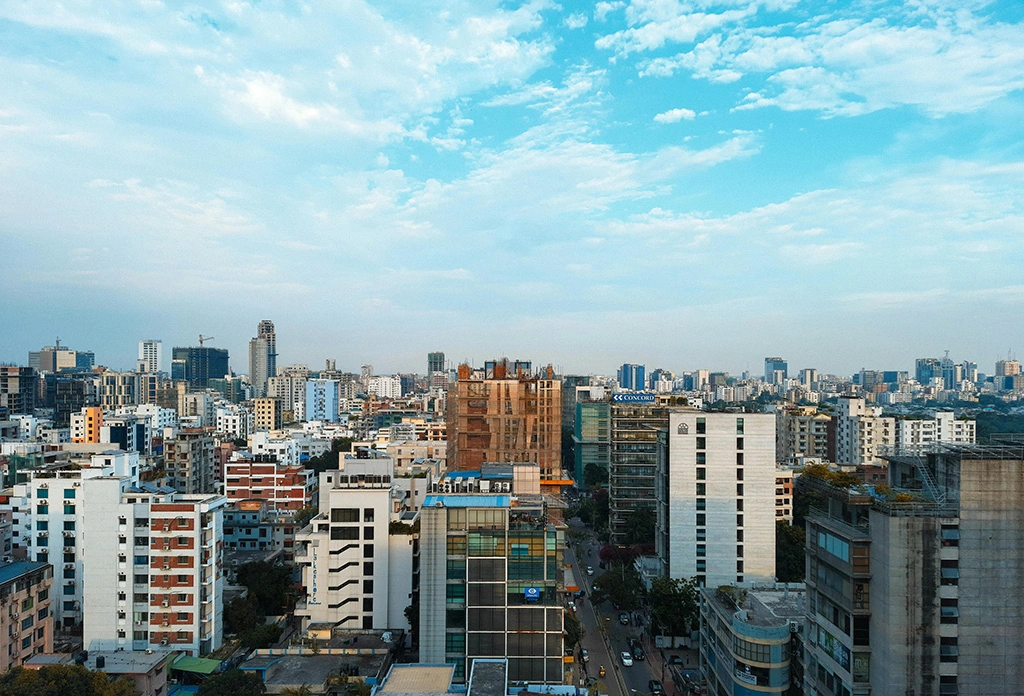
Common Locations: Dhaka, Chattogram, Sylhet urban properties (yellow zone)
Permit Considerations:
- Provide exact property GPS coordinates and plot boundaries
- Obtain written permission from property owner/developer
- If near airport, expect additional scrutiny and possible altitude restrictions
- Consider time-of-day flight windows to minimize traffic disruption
Client Coordination: Set realistic timeline expectations. Real estate clients often want quick turnaround, but 3-4 week permit processes are standard. Price your services to account for extended timelines.
But 3-4 week permit processes are standard for drone filming in Bangladesh. Price your services to account for extended timelines. For equipment options, explore our camera equipment rental services
Insurance Note: Real estate shoots typically require higher liability coverage due to populated area filming.
News & Event Coverage
High-Scrutiny Scenarios:
- Political rallies
- VVIP visits
- Large public gatherings
- Religious festivals
Special Requirements:
- Treat any VVIP event as automatic red zone (two-kilometre restriction for three days prior to event)
- Coordinate directly with event organizers AND local police
- May require real-time police liaison on-site
- Consider ground-based alternatives if permit denial risk is high
Timeline: For breaking news, drone footage may not be feasible within Bangladesh’s approval structure. Develop relationships with pre-approved operators for rapid response situations.
Infrastructure & Survey Work
Typical Projects: Construction monitoring, agricultural surveys, topographic mapping
Drone Requirements: Often heavier equipment (7kg+), triggering additional import scrutiny from Ministry of Defence
Operator Standards: Clients typically require:
- Certified Remote Pilot
- Survey/mapping-specific training
- Professional indemnity insurance
- BVLOS (Beyond Visual Line of Sight) certification if applicable (rare in Bangladesh)
Coordination: Work closely with client’s air traffic coordination if filming near active construction sites with helicopter traffic. For specialized surveying requirements, consult our aerial survey regulations guide. Understanding these scenario-specific requirements is essential for professional drone filming in Bangladesh.
Cost Breakdown: What to Budget for Drone Filming in Bangladesh
Budget $2,000-$4,000 for simple green zone shoots, $4,000-$7,000 for yellow zones, and $7,000-$15,000+ for red zone attempts (no guarantee). Costs include permits, insurance, import fees, and support services.
While exact fees fluctuate, here’s a realistic budget framework based on our production experience:
Core Permit Costs
- CAAB Drone Registration: Contact CAAB for current fee structure
- Remote Pilot Certification: Training + exam fees (if obtaining locally)
- Flight Clearance Application: Per-location, per-date fees apply
- MOD/NSI Clearances: Processing fees vary by project scope
Insurance Costs
- Basic Third-Party Liability: $500-$1,000 per production
- Comprehensive Coverage: $1,500-$3,000+ for high-value projects or red zone attempts
Import / Customs
- ATA Carnet: $200-$500 (if using international equipment)
- Customs Facilitation: $100-$300 (via fixer/production service)
- Temporary Import Bond: Variable, refunded upon equipment export
Support Services
- Local Fixer/Production Coordinator: $150-$400/day
- Police Liaison (if required)
Total Budget Estimate
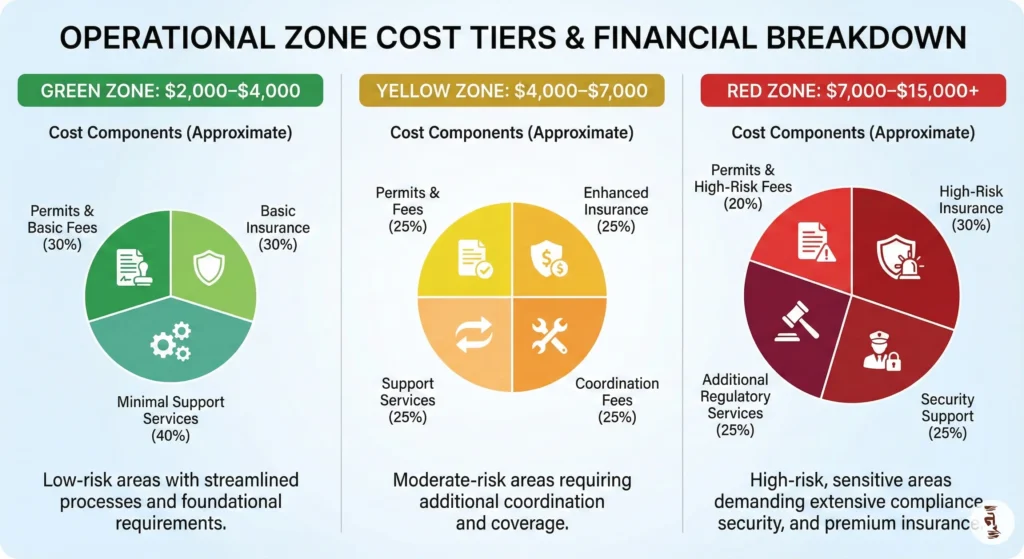
- Simple Green Zone Shoot: $2,000-$4,000 (permits, insurance, basic support)
- Complex Yellow Zone Shoot: $4,000-$7,000
- Red Zone Attempt: $7,000-$15,000+ (with no guarantee of approval)
Hidden Costs to Consider:
- Accommodation and per diem for extended approval waiting periods
- Multiple location fees if shooting across different zones
- Emergency equipment rental if yours is delayed in customs
- Translation services for documentation
Understanding the 2024 Draft Regulations: What’s Coming
The newly drafted “Drone Regulations 2024” introduce a stringent framework requiring operators to secure licences from CAAB for most types of drones. While not yet law, these proposed changes signal regulatory direction:
Key Proposed Changes
- Toy Drone Exemption Clarification
- Devices weighing less than 250 grams and lacking audio or video recording capabilities can be flown up to 100 metres without prior permission
- Creates clearer recreational vs. commercial distinction
- Mandatory Annual Competency Certification
- Remote Pilot Certificates will require annual renewal
- Continuing education requirements for operators
- Enhanced Airspace Zoning
- More precise geographical boundaries for red/yellow/green zones
- Digital geofencing database integration planned
- Formal two-kilometre buffer zones for VVIP events, effective three days prior
- Stricter Import Controls
- Approval must be obtained from both Ministry of Defence and Ministry of Home Affairs for importing drones or parts
- Focus on preventing high-powered drone misuse
- Potential for local manufacturing/assembly oversight
- Increased Penalties
- Legal action under the Penal Code of 1860 and CAAB Act of 2017 for violations
- Equipment confiscation provisions strengthened
- Permanent permit bans for egregious violations
Stay Current: Subscribe to CAAB announcements and join local drone operator associations to receive timely regulatory updates affecting drone filming in Bangladesh.
Troubleshooting Common Permit Challenges
Common issues include application delays (follow up every 7 days), red zone denials (explore alternatives), customs seizures (never travel without MOD clearance), weather delays (use permit date flexibility), and location changes (apply for multiple locations upfront).
Issue: Application Delays Beyond Stated Timeline
Solution:
- Follow up via email and phone at 7-day intervals
- Request written status update referencing your application number
- Escalate through your local production coordinator if delays exceed 10 days beyond stated timeline
- Consider engaging a professional permit service (Nree Productions offers expedited coordination)
Issue: Red Zone Permit Denial
Solution:
- Request specific denial reasons in writing
- Explore alternative shooting angles from adjacent green/yellow zones
- Consider ground-based elevated platforms (cranes, rooftops) with standard location permits
- For certain infrastructure shoots, time-lapse or long-lens ground footage may achieve similar results
Issue: Customs Equipment Seizure
Prevention:
- Never travel without pre-obtained MOD clearance letter
- Carry 3 printed copies of all import documentation
- Declare drone equipment proactively at customs, don’t wait for inspection
- Work with experienced fixers who have customs relationships
If Seized:
- Request detention receipt with equipment serial numbers
- Contact MOD and CAAB immediately with clearance documents
- Work through embassy/consular channels if you’re an international crew
- Budget 3-7 days for resolution even with proper documentation
Issue: Weather Delays After Permit Approved
Solution:
- Most permits include date ranges rather than single days—use flexibility within approval window
- Operations may only be conducted during daylight hours and in Visual Meteorological Conditions (VMC)
- If weather extends beyond permit window, apply for extension immediately (usually faster than new application)
- Include weather contingency days when planning permit dates
Issue: Last-Minute Location Changes
Reality: Each location requires specific GPS coordinates in the application. Changing locations typically requires new application.
Workaround:
- Apply for multiple nearby locations simultaneously if your shoot list is tentative
- Keep backup ground-based shooting plans
- Build location flexibility into client contracts and timelines
Comparing Bangladesh to Regional Drone Regulations
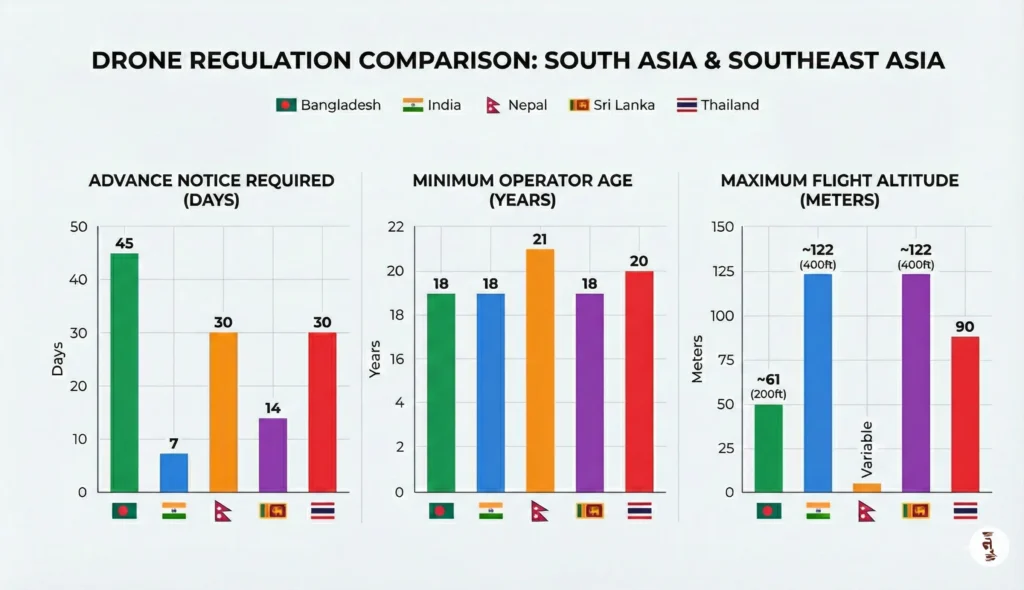
Bangladesh has the strictest advance notice requirement (45 days) in South Asia. India requires only 7 days, Nepal 30 days, Sri Lanka 14 days, and Thailand 30 days. Plan accordingly for multi-country shoots.
| Country | Advance Notice | Operator Age | Max Altitude | Recreational Under 250g |
| Bangladesh | 45 days | 18+ | 200 feet AGL | Permit required (current) |
| India | 7 days | 18+ | 400 feet AGL | No permit (nano drones) |
| Nepal | 30 days | 21+ | Variable by zone | Registration required |
| Sri Lanka | 14 days | 18+ | 400 feet AGL | Registration required |
| Thailand | 30 days | 20+ | 90 meters | Permit required |
Key Takeaway: Bangladesh has among the strictest advance notice requirements in South Asia. Plan accordingly when coordinating regional shoots.
Why Work with Professional Production Services
Professional services prevent expensive delays, provide CAAB relationships for faster processing, handle customs clearance, coordinate insurance, and offer backup equipment—typically saving more than they cost.
What Nree Productions Provides:
Permit Coordination:
- Complete application preparation and submission
- Multi-agency liaison and follow-up
- Document translation and notarization
- Timeline management and status updates
Local Knowledge:
- Real-time airspace zone updates
- Relationship with CAAB officials for expedited processing
- Understanding of informal requirements beyond written regulations
On-Ground Support:
- Customs clearance facilitation (equipment in/out under 1 hour)
- Police liaison coordination for sensitive shoots
- Backup equipment rental if yours is delayed
- Crew and driver services
Risk Mitigation:
- Insurance coordination
- Emergency contingency planning
- Legal support if issues arise
Cost-Benefit: While professional services add upfront costs ($1,000-$3,000 depending on complexity), they typically prevent far more expensive delays and complications. For international crews, the time savings alone justifies the investment.
Frequently Asked Questions About Drone filming in Bangladesh
These are the most frequently asked questions we receive from filmmakers planning drone filming in Bangladesh projects.
Yes, if it has a camera or is used for commercial filming. While the 2024 draft regulations propose exemptions for toy drones weighing less than 250 grams without recording capabilities, current CAAB practice requires permits for any camera-equipped drone used for filming purposes, regardless of weight. This includes popular models like DJI Mini series.
If it’s truly toy-class and used only recreationally without any recording capabilities, the draft 2024 regulations suggest lighter rules—but under current enforcement, you must still declare it when filming. Until new regulations are officially implemented, treat all filming drones as requiring full permits.
Typically 7-14 business days for standard shoots in green zones; high-risk or red-zone shoots could take 4-6 weeks or longer.
Detailed Timeline Breakdown:
Green Zone Shoots: 14-21 business days typical
Yellow Zone Shoots: 21-30 business days
Red Zone Shoots: 30-60+ business days (with no guarantee of approval)
Critical Rule: Authorizations must be submitted 45 days in advance to CAAB. While some green zone permits process faster, always budget for the maximum timeline to avoid production delays.
Pro Tip: Submit your application 45-60 days out regardless of zone classification to avoid last-minute complications.
Generally you must fly below 120 meters (400 feet) unless explicitly authorized, and maintain visual line-of-sight unless it’s a certified BVLOS (Beyond Visual Line of Sight) operation.
Specific Operational Limits:
Maximum Altitude: 200 feet above ground level (AGL) for most operations (approximately 60 meters). Some sources reference 120 meters (400 feet)—always confirm current limits with CAAB for your specific project.
Line of Sight: Drones can only be operated within visual line of sight of the operator at all times
BVLOS Operations: Require special certification and approval (rare in Bangladesh)
FPV Systems: First-person view systems require separate permit authorization
Distance Requirements:
Maintain 300 meters from buildings, vehicles, people, or animals not involved in operations
Stay 9 kilometers from built-up areas without specific clearance
Keep 18.5 kilometers from airports unless authorized
Yes. Near airports you’re in yellow zone; near military bases, border zones, or VVIP events you’re likely in red zone—expect stricter clearance and possible outright no-fly cases.
Airport Regulations:
Maintain 18.5 kilometers (10 miles) distance without authorization
Within 3.5 kilometers of airports: maximum altitude restricted to 100 feet
Coordinate directly with aerodrome operator and air traffic control for any operations within controlled airspace
File flight plans at least 48 hours in advance
Military Installations & Sensitive Areas:
Classified as red zones with highest security restrictions
Often complete no-fly zones regardless of permit applications
Unauthorized operation results in immediate detention and equipment confiscation
Border areas with India and Myanmar fall under same restrictions
VVIP Events:
Automatic two-kilometre no-fly buffer zone
Restrictions begin three days before event
Apply through security agencies at least 45 days in advance
Non-compliance can lead to equipment seizure, legal penalties under the CAAB Act of 2017 and the Penal Code of 1860, and refusal of future permits.
Specific Consequences:
Immediate: Equipment confiscation on-site
Legal: Criminal charges and fines (amounts vary by violation severity)
Administrative: Permanent ban on future permit applications
Security: Detention for questioning if national security concerns exist
Civil: Liability for any damages or injuries caused
Real-World Impact: Beyond legal penalties, unauthorized flights damage your professional reputation and can jeopardize future projects in Bangladesh. Insurance claims may be denied if operations were conducted illegally.
Bottom Line: Non-compliance risks far outweigh any time or cost savings from skipping the permit process.
Yes—commercial aerial filming is treated as “general-use drone” operation and triggers full permit requirements, regardless of drone size.
Commercial vs. Hobby Classification:
Commercial Use (Full Permits Required):
Advertising and marketing content
Real estate photography/videography
Travel vlogs or tourism content intended for publication
Social media content for business purposes
Documentary production
News and event coverage
Infrastructure surveys and mapping
Any footage that serves promotional or business purposes
Hobby Use (Still Requires Declaration):
Personal recreational flying
Family videos not for public distribution
Private practice sessions
Key Distinction: Even if you’re filming for YouTube or personal projects with intention to publish, CAAB treats it as commercial activity. The intent to share publicly triggers commercial regulations.
Requirements Triggered by Commercial Use:
Mandatory CAAB flight clearance
Remote Pilot Certification
Third-party liability insurance
Multi-agency security clearances
Detailed flight plan submissions
Equipment registration with UAS-ID
Liability insurance covering risks of injury or damage to public and/or property is mandatory for all types of drone operations in Bangladesh.
Minimum Coverage Requirements:
Third-party bodily injury: Minimum $500,000 recommended
Property damage: Minimum $250,000 recommended
Equipment coverage: Full replacement value of your drone and backup gear
Professional liability: Required if working for commercial clients
Insurance Details:
Policy must be issued by or validated through a Bangladesh-recognized insurance provider
International policies may require local validation
Coverage must be active for entire production period
Proof of insurance required during permit application and on-site operations
Cost Range: $500-$2,000+ per production depending on coverage limits, duration, and risk assessment.
Where to Obtain:
International production insurance extended to Bangladesh operations
Local insurance providers (coordinate through production service company)
Nree Productions can facilitate insurance coordination for client productions
Request written explanation of denial reasons, address the stated concerns, and consider alternative locations or filming methods if the location is permanently restricted.
Steps to Take After Denial:
Request Written Explanation: Get specific denial reasons in writing with application reference number
Assess Denial Type:
Temporary (requires additional documentation)
Permanent (location prohibited for security reasons)
For Temporary Denials: Address stated concerns and resubmit with complete documentation
For Permanent Denials: Explore alternative locations or ground-based filming methods
Common Denial Reasons:
Incomplete security clearances (MOD, NSI approvals missing)
Insufficient operational safety documentation
Location within permanently restricted red zone
Conflicting airspace activity (military exercises, VVIP movements)
Insurance coverage inadequate for proposed operations
Operator certification issues
Reapplication Process:
After addressing all stated concerns, typically no mandatory waiting period
Repeated applications without addressing core issues may result in application blocks
Consider working with professional permit service to identify and resolve issues
Alternative Solutions:
Adjacent green/yellow zone locations with similar visual characteristics
Ground-based elevated platforms (cranes, rooftops with standard location permits)
Long-lens cinematography from authorized positions
Time-lapse or other creative techniques
Yes, and this can simplify logistics significantly. Several Dhaka-based production companies offer equipment rental, certified operators, and turnkey drone services.
Advantages of Local Rental:
Avoids Import Delays: No MOD clearance or customs procedures required
Pre-Registered Equipment: Drones already registered with CAAB and have UAS-IDs
Experienced Operators: Local pilots familiar with Bangladesh regulatory requirements
Immediate Support: Backup equipment and technical support readily available
Insurance Simplified: Often included in rental package
Cost Effective: Eliminates import fees, carnets, and equipment transport costs
What’s Available Locally:
Equipment: DJI Phantom 4 Pro, Mavic 3, Inspire 2 series
Operator Services: CAAB-certified Remote Pilots with current licenses
Turnkey Packages: Full permit coordination, equipment, operators, insurance, and ground support
Typical Rental Costs:
Basic drone + operator: $300-$600/day
Premium equipment packages: $800-$1,500/day
Multi-day discounts available
Nree Productions Fleet: We maintain professional camera drones, certified operators, and complete production support services. Contact us for current availability, rates, and package options tailored to your project needs.
Related Resources
- Drone Import Clearance Bangladesh: Complete customs and MOD approval guide
- Film Production Permits in Bangladesh: Beyond drones—full filming permit overview
- Aerial Survey Regulations Bangladesh: Specialized requirements for mapping and surveying
- Equipment Rental in Bangladesh: Camera gear, drones, and crew services
Conclusion: Master the Process, Capture Stunning Footage
Start 45-60 days early, know your airspace zone, budget realistically, get professional help if unfamiliar with Bangladesh bureaucracy, and always have backup plans. The stunning footage is worth the proper preparation.
Key Takeaways:
- Start Early: 45-60 days minimum before your shoot date
- Know Your Zone: Green, yellow, or red classification determines approval difficulty
- Get Professional Help: Unless you’re familiar with Bangladesh bureaucracy, production coordinators save time and headaches
- Budget Realistically: Permits, insurance, and compliance costs are non-negotiable
- Plan Backups: Weather, permit delays, and location changes require contingency plans
Whether you’re producing a high-budget commercial or an independent documentary, understanding and respecting Bangladesh’s drone regulations protects your project and your investment. The footage you’ll capture is worth the process.
Ready to Fly? Let Nree Productions Handle the Details
Nree Productions specializes in aerial filming coordination throughout Bangladesh. With over a decade of experience supporting international productions, we provide:
- Complete Permit Coordination – CAAB clearance, security approvals, customs facilitation
- Certified Operators – Licensed Remote Pilots with local expertise
- Equipment Fleet – Latest DJI professional drones and backup systems
- Pre-Flight Compliance Check – Risk assessment and safety protocols
- On-Ground Support – Crew, drivers, police liaison
Contact us today for a custom compliance package tailored to your production.
Last Updated: May 2026
Note: Drone regulations in Bangladesh are subject to change. Always verify current requirements with CAAB before beginning your project.
