
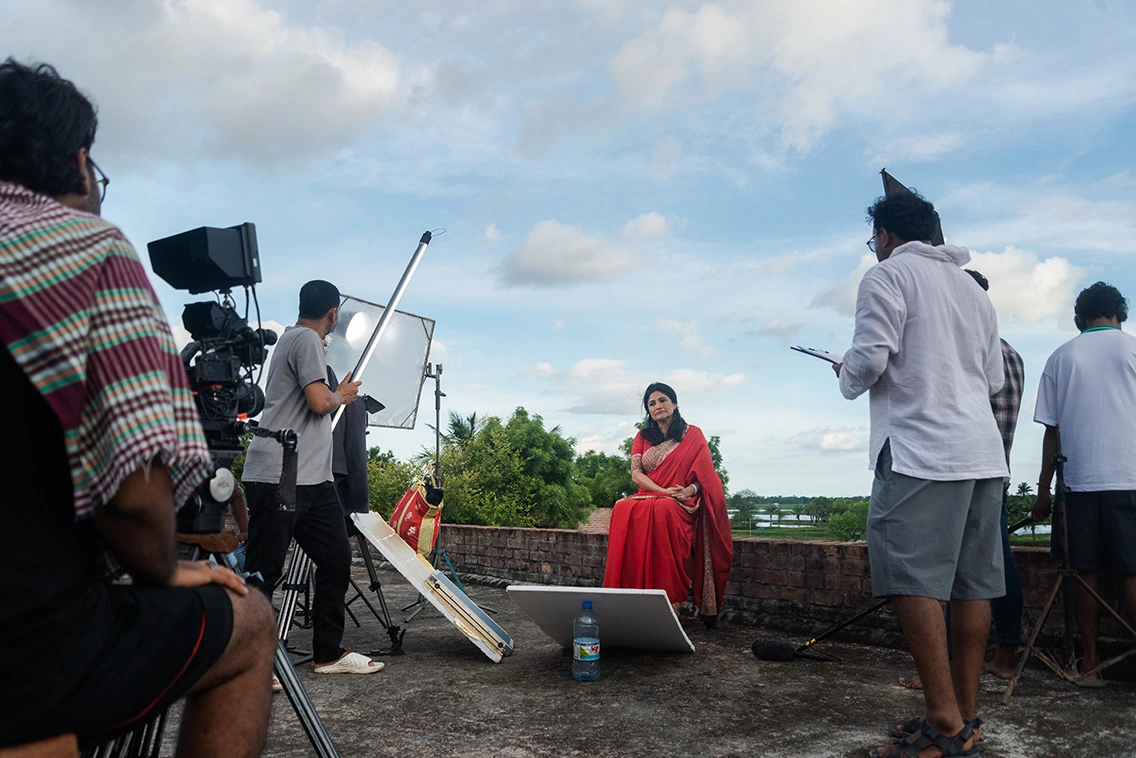
Foreign productions come to Bangladesh for stories that are otherwise inaccessible: climate migration, river erosion, garment labour, monsoon cities, delta faith, or container ports changing Asia’s economy. But the difference between a finished film and a stalled attempt is rarely the camera — it is whether you hire a local crew in Bangladesh who already understand the country’s practical and cultural constraints.
Bangladesh is shootable, responsive and cost-efficient — but only when you recruit people who already know how to move inside its practical and cultural constraints. This guide distills the hiring logic foreign teams actually need on the ground — not theory.
Understanding the Production Landscape in Bangladesh Before You Hire
Bangladesh is not “difficult” by default — it is conditional. The right crew converts bureaucracy and social frictions into access and continuity.
Most international film teams arrive with a mental model shaped by India or Nepal or South-East Asia, which fails fast in Bangladesh. Three realities define the work here:
1) State & institution are transactional, not streamlined
Permissions are not “automated” even when documents exist. Things move through people before paper — and access depends on who calls, not only what form is filed.
2) Social trust outruns credentials
A location owner, union leader, religious authority, port officer, or fishing-dock cooperative will not engage outsiders unless a trusted local intermediary stands in between. This is where crews with existing social credit shorten time and reduce suspicion.
3) Logistics punish outsiders who assume “we’ll fix it live.”
Sundarbans, chars, saline belts, coastal ports, and border towns operate on micro-logics: tide tables, ferry clearances, patrol windows, fuel ration days, religious processions, wedding seasons, Eid closures, exam season blackouts. These rhythms are not visible online; they are known through lived repetition.
Hiring local crew in Bangladesh is therefore not an efficiency choice — it is the operating system that makes foreign production possible.
What Types of Local Crew Can You Hire in Bangladesh? (Three Tiers You Must Distinguish)
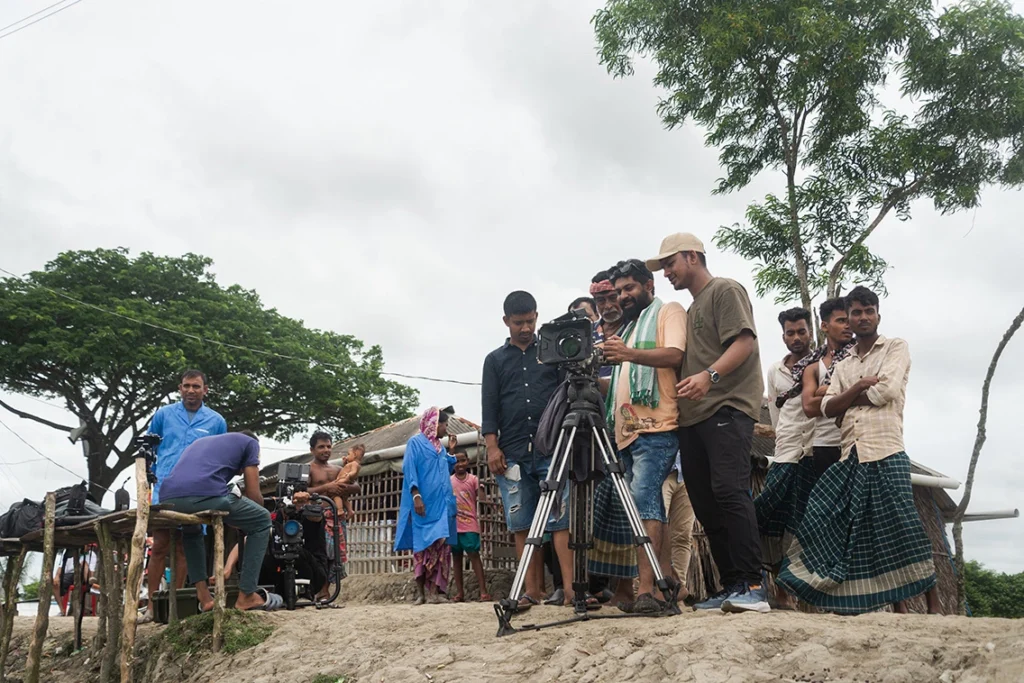
Don’t “just hire a fixer”. Build to the tier your film actually demands — minimal, field unit, or full production — not what is convenient.
Foreign productions often hire too little or too late. Whether you need to hire fixer Bangladesh services alone or build a complete field unit, clarity at the tier-definition stage prevents costly mistakes:
Tier-1: Minimal Access Crew
Who: Fixer + Driver + Translator
Use when: Observational doc, single-camera journalism, sensitive or fast-moving stories, exploratory travel recce, editorial work under tight time constraints. Outcome: Mobility and negotiation coverage, not a high crew footprint.
Tier-2: Structured Field Unit
Who: Fixer + Camera AC + Sound + PA + Driver (sometimes 2 vehicles)
Use when: Broadcast doc, branded content, repeat return to same characters/locations, sync sound, managed sit-downs, institutional interviews.
Outcome: Technical stability plus cultural buffer.
Tier-3: Full Production Crew
Who: Line producer, DoP, Sound Lead, Gaffer/Light, Drone/UAV operator, Art/Props, Medic, Safety, Permit liaison, Runners
Use when: Narrative doc-hybrids, commercials, multi-location days, rigging, night work, celebrity/political subjects, or any risk-exposed environment.
Outcome: Industrial reliability — continuity without gambling on luck
Choosing the wrong tier is the single biggest hidden reason foreign shoots collapse in Bangladesh.
You may also like our guide on Filming Permits in Bangladesh
Local Crew Rates in Bangladesh: 2025 Pricing Guide
One of the most common questions from international filmmakers: “How much does it cost to hire a local crew in Bangladesh?” Here’s transparent pricing based on current market rates:
Individual Crew Member Rates (Per Day)
Production Coordinators & Fixers:
- Entry-level fixer: $100–150/day
- Experienced fixer (5+ years, international clients): $200–450/day
- Line producer: $250–500/day
Camera Department:
- Camera operator (with own gear): $150–500/day
- DoP (Director of Photography): $250–800/day
- Camera assistant/AC: $100 – 200/day
- Drone/UAV operator (with license & equipment): $200–400/day
Sound Department:
- Sound recordist (with kit): $120–250/day
- Boom operator: $80–120/day
Lighting & Grip:
- Gaffer: $120–200/day
- Grip/lighting assistant: $60–100/day
Support Roles:
- Production assistant: $50–100/day
- Driver (with vehicle): $150–500/day
- Translator: $80–150/day
- Security/safety personnel: $60–100/day
Package Rates (Per Day)
Minimal Access Package (Tier-1): $400–700/day
- Minimal Access Package (Tier-1): $400–700/day
Structured Field Unit (Tier-2): $900–1,600/day
- Fixer, Camera AC, Sound recordist, PA, Driver, 1-2 vehicles
Full Production Crew (Tier-3): $2,200–4,500/day
- Complete crew including DoP, Sound lead, Gaffer, Drone operator, Line producer, Support staff, 2-3 vehicles
What Affects Pricing:
- Years of experience and an international client portfolio
- Equipment included vs. crew-only rates
- Location remoteness (Sundarbans, border areas cost 15-30% more)
- Season (monsoon/cyclone season may increase rates)
- Project duration (weekly/monthly discounts available)
- Hazard exposure (political events, conflict zones)
Important: All rates are approximate and subject to project specifics. Equipment rental is typically separate unless specified. Contact us for a detailed quote based on your production needs.
Film Equipment Rental & Technical Support in Bangladesh
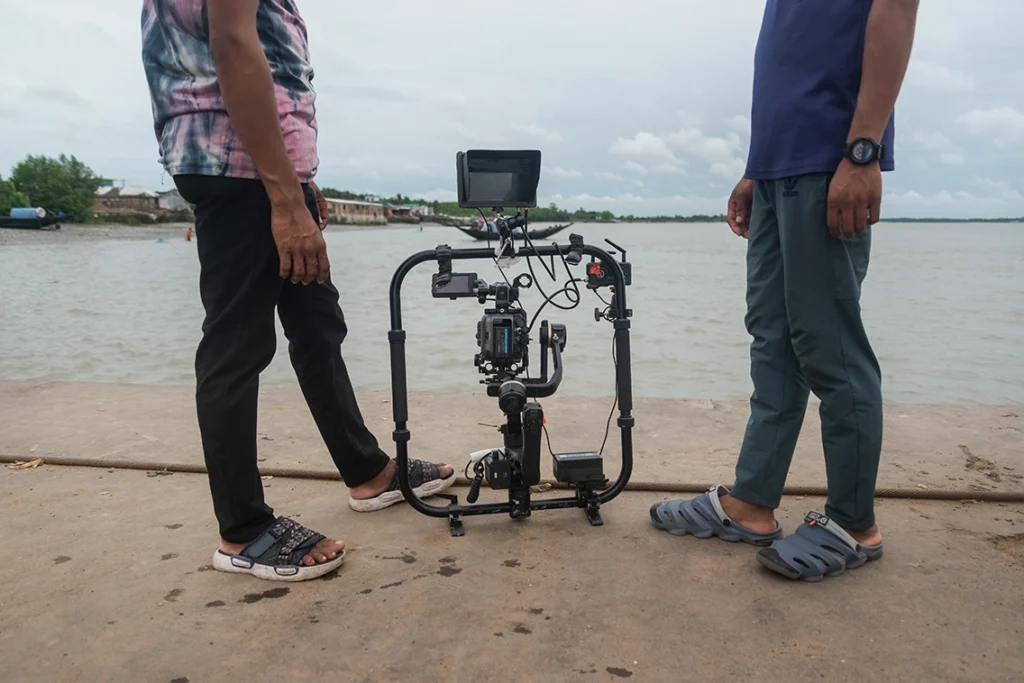
When you hire a local crew in Bangladesh, equipment access is equally critical. We partner with Bangladesh’s top rental houses and maintain relationships with reliable suppliers across all major cities.
Camera Packages Available
Broadcast Quality:
- Sony FS7 / FS5 packages
- Canon C300 Mark II / C200
- Panasonic EVA1
- Blackmagic Pocket Cinema Camera 6K
High-End Cinema:
- ARRI / ALEXA / RED Komodo / Scarlet-W (limited availability)
- Sony FX3/ FX6 / FX9
- Canon C70 / C500
Documentary & Run-and-Gun:
- Multiple Sony A7S III / A7 IV kits
- Canon R5 C / R6
- DJI Ronin stabilizers
Lighting & Grip Equipment
- LED panel kits (Aputure, Godox)
- HMI lights (1.2K to 4K)
- Tungsten fixtures
- Softboxes, diffusion, flags, C-stands
- Portable generators (essential for remote locations)
- Grip trucks available in Dhaka
Sound Equipment
- Sennheiser wireless systems (G3, G4)
- Rode NTG series shotgun mics
- Zoom F8n / Sound Devices recorders
- Boom poles, windshields, lavaliers
Drone/Aerial
- DJI Mavic 3 & 4 Pro
- FPV drones for specialized shots
- CAAB clearances
Why Equipment Matters in Bangladesh
Generic rental houses don’t understand production context. When you hire a local crew in Bangladesh through experienced networks:
- Equipment arrives tested and field-ready (not just charged)
- Backup gear travels to remote locations automatically
- Crews know which equipment survives humidity, dust, and river crossings
- Insurance and customs documentation handled properly
- 24/7 tech support during shoots
Equipment rental rates: Contact us with your specific gear list for customized pricing.
How to Evaluate a Local Crew Before You Hire (Non-Negotiable Criteria)
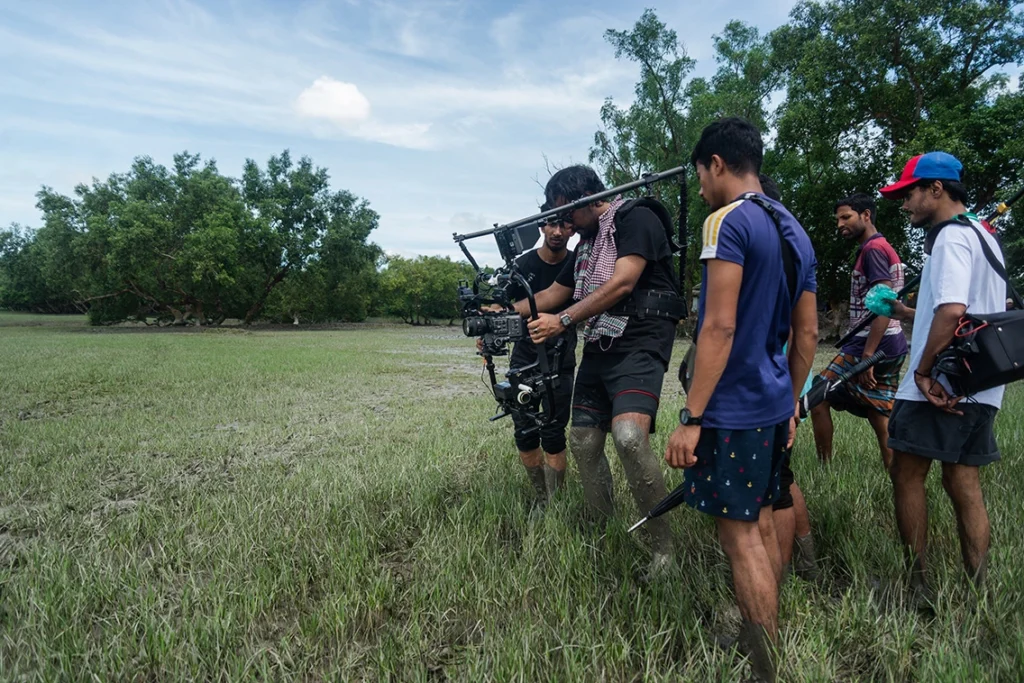
In Bangladesh, you don’t evaluate crews only by equipment or reel — you evaluate by access, interference-handling, and past accountability under pressure.
Do not treat crew selection like a generic supplier decision. Screen against these axes:
1) Provenance of projects, not portfolio beauty
Ask: “What did this team complete under constraint?” A perfect showreel from a comfortable set means less than a finished doc shot through coastal shutdowns or protest days.
2) Access track record (permits, characters, institutions)
Have they negotiated with: Port Authority? Police? NGO field bases? Union leaders? Border guards? Religious committees? Forest department? Agricultural blocks?
3) Cultural fluency under the camera
Bangladesh flares fast under misreads — a crew that anticipates offence before it happens saves days.
4) Interference-containment ability
Ask them to narrate one incident they neutralized: police challenge, ultra-local political interruption, religious objection, labour union confrontation, media hostility.
5) Continuity discipline
Did they deliver previous international productions on time and without legal residue (complaints, disputes, bans)?
If a crew cannot answer these with examples, not adjectives — don’t hire.
Where to Hire Reliable Local Crew in Bangladesh (Proven Sources)
The best crews are rarely found by open call — they come through reputation pathways already embedded inside production and field networks.
Avoid “post and hope”. In Bangladesh, reliability lives inside closed reputational circuits. Practical acquisition channels:
- Existing international broadcasters’ alumni crews — teams that have already executed for BBC / AJ / NHK / Netflix / Vice / NatGeo, etc.
- NGO communication units with field fluency — BRAC, ICDDRB, IUCN, CARE, UN field clusters (rare but valuable references).
- Fixer networks embedded in topical beats — climate, migration, ports, elections, labour, river chars, Rohingya response zones.
- Peer recommendations from previous foreign DPs / EPs — stronger than any open market call.
- Hybrid outfits with both journalism + production literacy — extremely high-value in conflict-sensitive or rights-adjacent work.
In Bangladesh, “production crew” refers not only to technical roles (DoP, AC, sound, gaffer, art, drivers) but also to access-critical roles such as fixers, permit liaisons, community intermediaries, safety hands, and cultural translators—whose function is to convert bureaucratic and social friction into operational continuity on shoot days.
Crew Contracts, Insurance, NDAs & Risk Variables in Bangladesh
Paperwork is not cosmetic here — it protects the foreign producer, not the crew. Use contracts to control fallout, not to impress anyone.
Bangladesh is reputation-driven in practice, but documentation protects you if something escalates. At minimum:
- Work-for-hire contract (scope, days, deliverables, kill clauses)
- Confidentiality / NDA when filming sensitive groups, minors, or litigated topics
- Insurance disclosure & responsibility — who holds what, who is named, and what exclusions apply
- Data custody rules — who touches cards, who copies, who travels with media
- Dispute escalation path — written before work begins, not after it goes wrong
Critical insight: Do not sign paperwork you cannot enforce. Instead, write agreements for containment, not confrontation — define behaviour and process, not punishment
Insurance Considerations
- Most experienced Bangladesh crews servicing international clients carry basic liability coverage.
- Production insurance should be arranged by foreign producers (Bangladesh crews typically cannot provide E&O, equipment, or comprehensive liability)
- Confirm crew insurance coverage before shoots in high-risk environments (Sundarbans, border areas, political events)
- Equipment rental insurance is separate and must be explicitly confirmed
Timelines, Seasons & Location Logic: When Crew Choices Change
Bangladesh does not run on calendar logic — it runs on monsoon, elections, holy days, tide, exams, and harvest. Crew planning must follow that reality.
Key temporal triggers foreign producers routinely miss:
- Monsoon & cyclone windows disrupt access roads, ferries, and schedules
- Election cycles & hartal culture alter police behaviour and street temperament.t
- Ramadan/Eid changes working hours, hospitality norms, and access to women/elders
- HSC/SSC exams close schools and restrict noise in certain zones
- Harvest & fishing bans alter labour availability and dock access.
- Tiger season rules (Sundarbans) change guard protocols, insurance, and guide requirements
Right crew = the team that already knows how these rhythms intersect your shoot days — not the team that learns on your time.
Pro tip: Book crews at least 3-4 weeks in advance during peak filming season (October-March). For Sundarbans, Cox’s Bazar, and remote locations, 4-6 weeks’ notice is recommended.
Common Mistakes Foreign Teams Make When Hiring Crew in Bangladesh
Most failures come not from “bad crew” but from foreign mis-specification at the hiring stage.
Typical recurring errors:
- Hiring late — booking crew after permits/locations instead of in parallel
- Hiring too small — assuming a fixer substitutes an entire field unit
- Hiring for price — choosing cheap hands over interference-handlers
- Hiring generically — picking “film people” without topical access (e.g., climate/labour/border/faith)
- Hiring without testing — no interview case question, no escalation scenario asked
- Ignoring seasonal constraints — booking monsoon shoots without waterproof backup plans
- Skipping equipment discussions — assuming “camera operator” means they bring broadcast-quality gear
- No backup crew contacts — single point of failure if someone gets sick or detained
The question is not “Can they shoot?” — it is “Can they still shoot when the country behaves like itself?”
How Nree Production Can Help You as Your Local Crew in Bangladesh
As your film fixer in Bangladesh, we provide boots-on-the-ground production support with a network of vetted local professionals who understand both the craft and the terrain.
- 20+ experienced fixers with international production credits
- 10+ camera operators and DoPs
- Licensed drone pilots with CAAB clearances
- Specialized crews for Sundarbans, Cox’s Bazar, and sensitive locations
- Emergency backup crews for last-minute replacements
📞 WhatsApp (24/7): +880-1714069155
📧 Email: contact@nreeproductions.com
📍 Based in Dhaka, Bangladesh
FAQ: Hiring Local Film Crew in Bangladesh
Common Questions from International Productions
Get quick answers about costs, timelines, permits, safety, and logistics for hiring fixers in Bangladesh.
Yes — in Bangladesh, a fixer is not a translator but the anchor who handles authorities, communities, and frictions that foreign crew cannot neutralize legally or socially. Even experienced international teams need local intermediaries. The decision to hire a fixer in Bangladesh services is essential regardless of your incoming crew’s experience level, as local context and relationships cannot be imported.
Minimal access crews (fixer + driver + translator) start around $400-700/day. Structured field units run $900-1,600/day. Full production crews with DoP, sound, lighting, and support staff cost $2,200-4,500/day, depending on experience and equipment included.
Standard fixer services include: permit navigation, location scouting, community liaison, authority negotiation, logistical coordination, cultural translation, risk assessment, and problem-solving. When you hire fixer Bangladesh professionals, they typically do NOT include: camera operation, equipment, translation services (unless specified), or driving (driver is a separate role). Experienced fixers are your primary access point to institutional and community networks.
Yes, if you vet via structured interviews and request references from past international productions or NGOs working in the same geography/beat. Video calls with portfolio review and scenario-based questions work well. However, on-ground recce with the shortlisted crew is still recommended for complex productions.
No. In practice, you often onboard crew early so permit pursuit, access-building, and negotiation run in parallel rather than sequentially. Experienced fixers actually help secure permits — they’re not contingent on permits already existing.
Most senior fixers, line producers, DoPs, and sound recordists servicing foreign productions are functional to fluent in English. Camera assistants, drivers, and PAs typically have basic to no English — plan for layered communication with key crew members translating to support staff.
Yes, with a vetted local crew who understands the context. Risk comes mainly from political moments, weather events, and cultural misunderstandings with communities — all mitigated by experienced intermediaries who read situations before they escalate.
You can, but Bangladesh drone use intersects with Civil Aviation Authority Bangladesh (CAAB) regulations, police permissions, and locality-specific rules. A local licensed UAV operator lowers rejection risk, shortens negotiation loops, and handles paperwork that foreign pilots cannot navigate easily.
Established crews working with international clients typically carry basic liability coverage, but foreign producers should arrange comprehensive production insurance themselves. Confirm specific coverage before high-risk shoots (political events, Sundarbans, border areas).
Most experienced crews accept: bank transfer (local and international), cash (USD or BDT). Payment terms are typically 50% advance, 50% on completion, though this varies by project scope and crew relationship.
Yes — experienced Bangladesh crews regularly handle multi-camera broadcast productions, interviews with ISO recording, and synchronized sound across multiple units. Confirm specific technical requirements during crew vetting.
As early as budgets and schedules exist, Bangladesh punishes late crew onboarding more than most markets. Minimum 3-4 weeks for standard productions; 4-6 weeks for Sundarbans, Cox’s Bazar, or remote locations; 6-8 weeks during peak season (October-March) or around elections/major events.
