
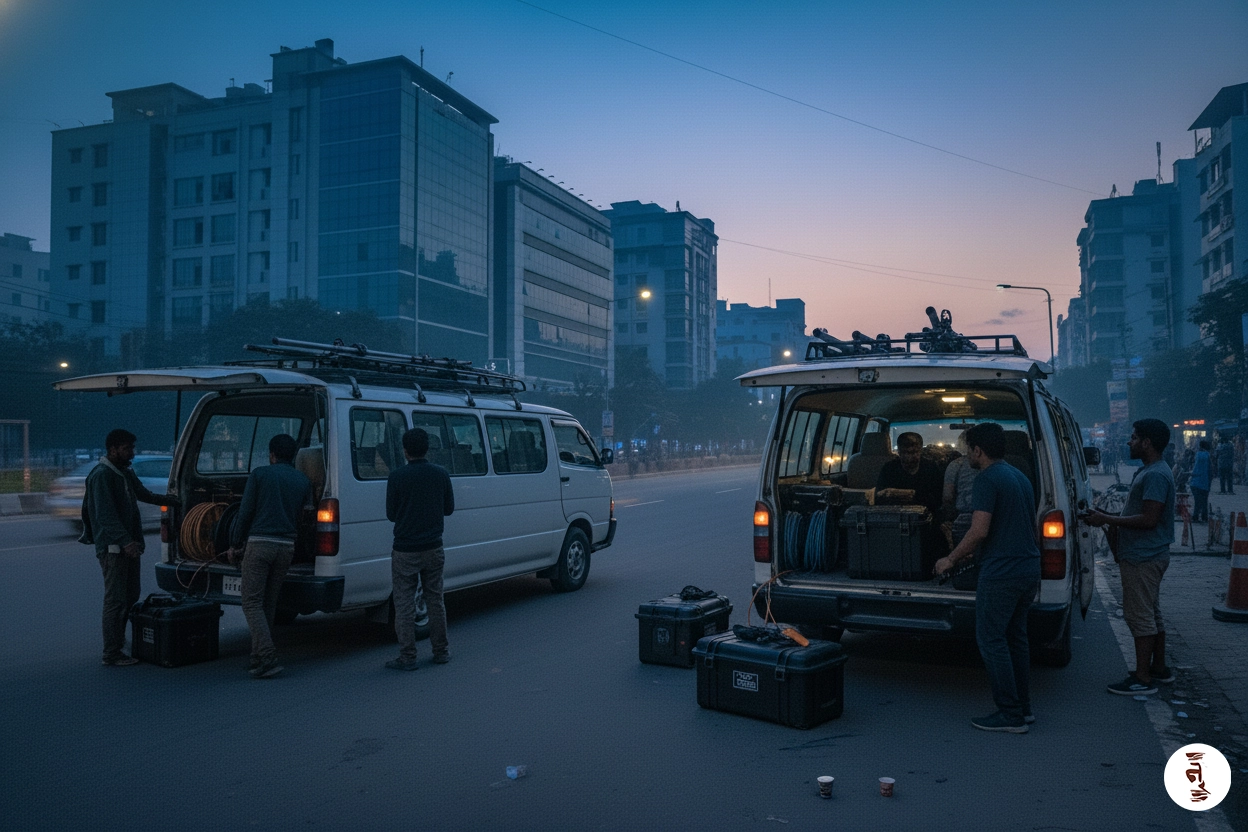
Safe film crew transport in Bangladesh determines whether your shoot succeeds or fails. Planning shoots in Bangladesh often collapses not because of the story, but because of the road. Crews land with solid scripts and budgets and lose two shooting days to a mis-timed ferry, the wrong vehicle, or a driver who has never handled film equipment or early-call logistics. For complete guidance on working with local fixers, see our guide to hiring a fixer in Bangladesh.
For foreign units especially, transport logistics are not a secondary line item — it is the spine that holds schedule, gear, and editorial intent together.
A robust transport plan must be built around terrain, climate, crew size, shooting sensitivity, and the ability to pivot when Dhaka traffic or monsoon weather turns. This guide distills the field-proven logic used by local fixers and line producers before any wheels move.
Safe Film Crew Transport in Bangladesh: Understanding the Landscape
Bangladesh is geographically compact but logistically deceptive. A 90-kilometer stretch can swing between two hours and six hours depending on rain, ferry backlog at the Daulatdia–Paturia crossing, political rallies, or container traffic near Chattogram Port. Major corridors like Dhaka–Chattogram, Dhaka–Sylhet, and Dhaka–Khulna offer smooth highways, while coastal regions (Sundarbans, Kuakata) and the Brahmaputra delta still rely on narrow rural roads, embankments, or river routes.
For film crew logistics in Bangladesh, what matters is not map distance but friction points:
- Urban choke points — Dhaka exits can eat half a day if call times are wrong
- Monsoon & tidal influence — wet seasons rewrite road quality overnight
- Ferry dependencies — a perfect schedule can die at a queue on Padma/Meghna (Though modern bridges have solved this problem in most cases)
- Night vs day windows — the same road behaves differently by hour and day of the week.
Different filming locations across Bangladesh present unique transport challenges—from the Sundarbans delta requiring boat access to the Chittagong Hill Tracts needing 4×4 clearance. For comprehensive regional logistics and location-specific transport considerations, see our guide to filming locations in Bangladesh.
Choosing the Right Vehicle Class for Production Work
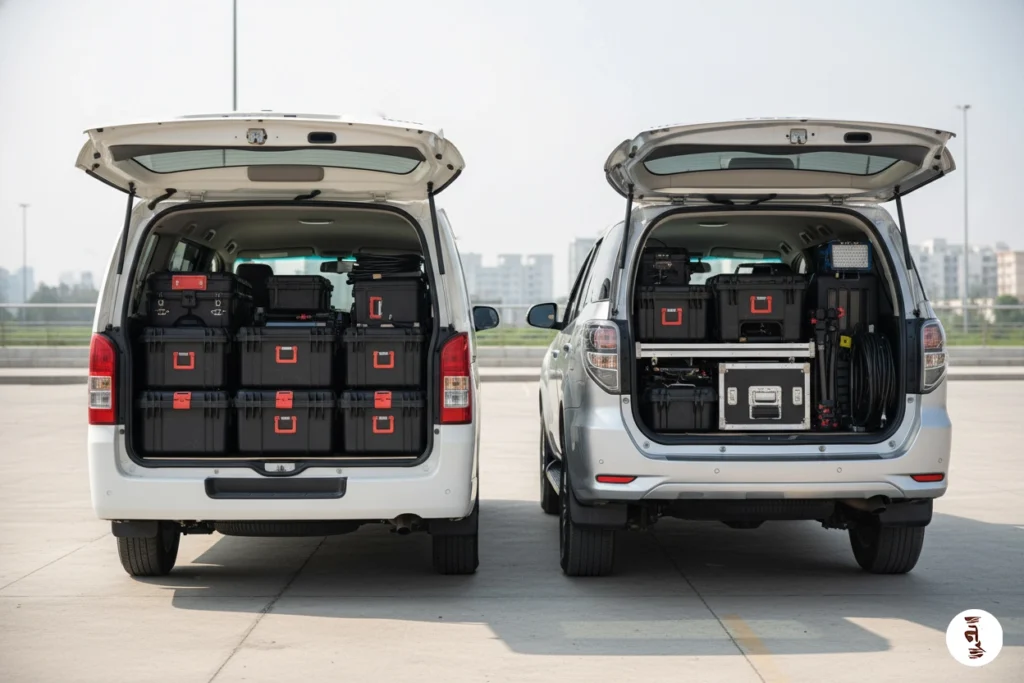
Match vehicle to mission — crew safety comes from suitability, not brand or price.
Different productions need different transport logic. The most common classes used for production transport in Bangladesh include:
1) MPV / Minivan (Noah / HiAce class)
Best for small–mid crews moving between multiple locations in one day. Space for cases, stable suspension, and AC for long waits.
Use when: Interviews, urban docs, branded shoots, multi-stop recce days.
2) SUV (Pajero / Fortuner / Prado class)
More torque and clearance for uneven village access, embankments, or cyclone-prone belts.
Use when: Coastal or rural filming, sensitive environmental terrain, travel with HODs.
3) Pickup + Cover / Manual Loaders
Used when rigs, lighting, or water production items travel separately from crew seats.
Use when: Heavy production days, split units, art/logistics transport.
4) Ferry-Integrated Routing (Car-on-ferry days)
Not a vehicle type, but a critical planning condition. When ferries are unavoidable, the vehicle class must factor in exit/entry timing and ground clearance.
To hire a vehicle for filming in Bangladesh, first lock:
- Crew count → dictates seat class
- Gear volume → second vehicle or pickup?
- Terrain mix → highway vs river-adjacent vs earthen roads
- Call-time reality → night/early departures often beat traffic.
- Hold time → vehicles must be booked for full-day idle, not trip-by-trip
Driver Selection Matters More Than the Vehicle Itself
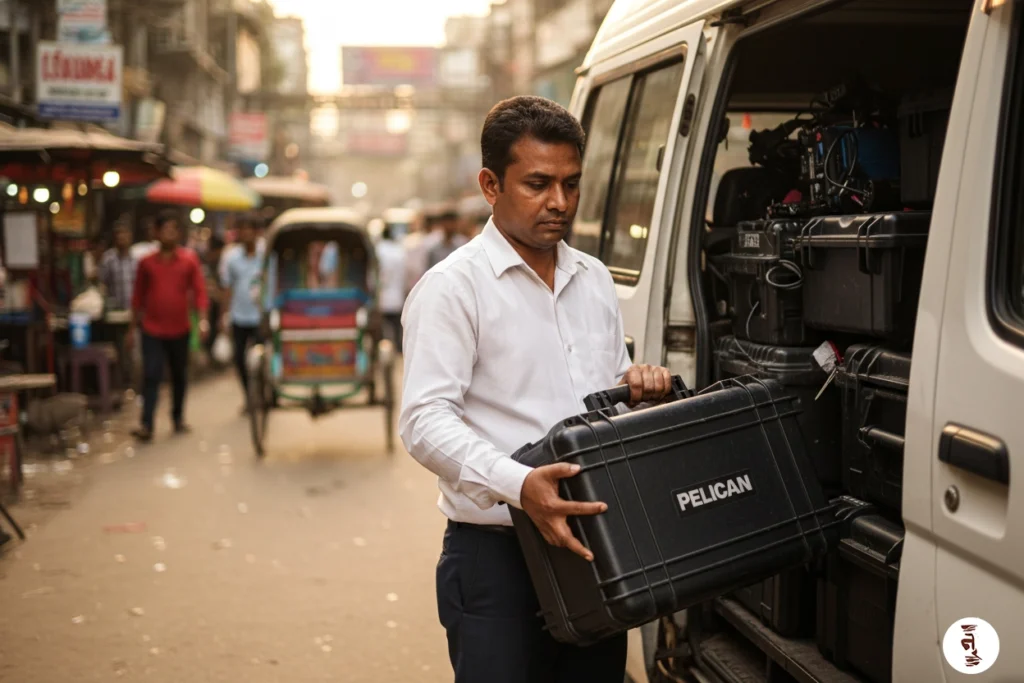
A trained production driver prevents delays more reliably than an expensive car.
In Bangladesh, two identical vehicles can produce opposite production outcomes purely based on who is driving. A good driver for journalism or film is not just a “safe driver” — they are timeline-literate, location-literate, and production-literate.
What experienced fixers check when arranging fixer-led transport in Bangladesh:
- Knows filming rhythm — understands that waiting on location is normal
- Zero improvisation with routes — does not “try something new mid-day.”
- Understands fragile cargo — no sudden braking with glass, audio, or rigs
- Comfort with dawn calls — can execute 3–5 AM rollouts reliably.
- No mid-job reassignment — same driver stays through the schedule block.k
- Understands NDA instinctively — does not discuss crew or work locally
A new highway can shave 40 minutes.
A wrong driver can lose the day.
Production teams should also review filming permit requirements since transport often coordinates with permission timing.
Security & transport for journalists in Bangladesh
For international journalists and documentary crews, security & transport for journalists in Bangladesh requires additional considerations beyond standard production transport. When covering sensitive stories, transport plans must include discreet vehicle selection, route variability, and drivers briefed on security protocols.
Crews working on investigative or conflict-adjacent stories benefit from transport arrangements that include communication protocols, check-in systems, and contingency extraction routes. For journalists covering sensitive humanitarian situations, specialized transport and security protocols are essential—see our guide to filming in Rohingya camps for scenario-specific requirements.
Routing, Timing, and Call-Sheet Discipline
In Bangladesh, you don’t beat distance — you beat timing. Call times are the safety margin.
Two production crews can travel the same route and lose six hours of differential just by departing at the wrong hour. For location travel logistics in Bangladesh, the clock is the strongest tool:
Practical timing rules used by fixers:
- Exit Dhaka before the city wakes (03:30–05:00 departure)
- Cross major bottlenecks before office hour ramps (08:30–10:30)
- Avoid post-maghrib re-entries on urban corridors when possible.
- Treat Fridays as strategic “fast-road days” for long hauls.
- Schedule ferries away from Eid-season and storm windows
Production call-sheets should state wheels rolling, not “crew ready.” Transport safety comes from a decisive rollout, not from late assembling on the ground floor while the car idles. A 30-minute hesitation in Dhaka can cost 3 hours downstream.
Contingency Planning Is Not Optional — It Is Design
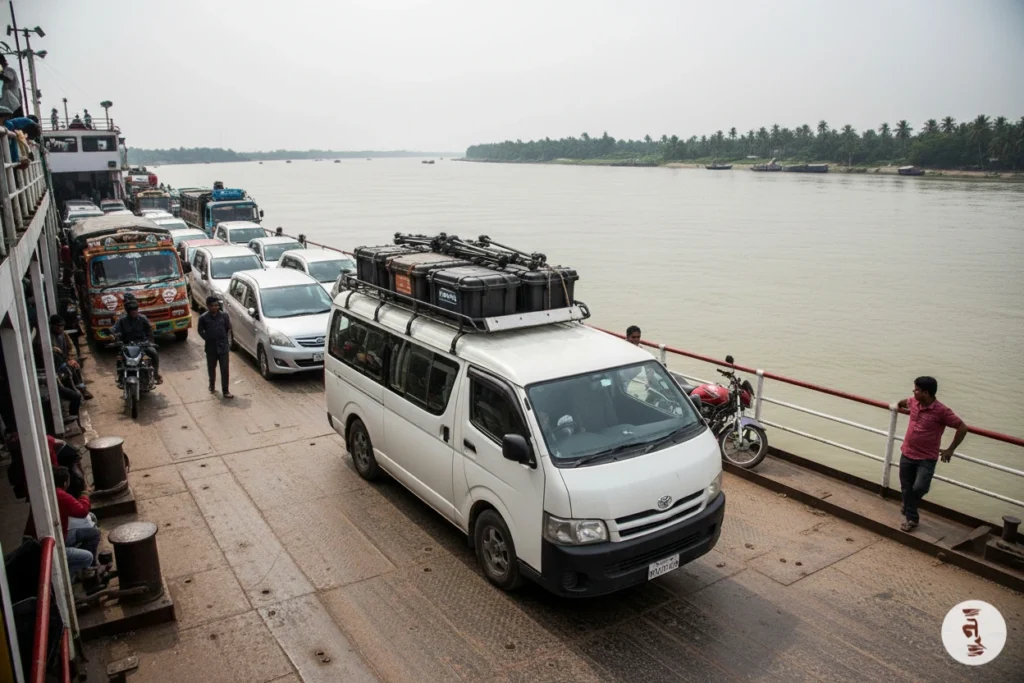
Assume one thing will fail — plan so it doesn’t matter.
The crews that move smoothly in Bangladesh are not lucky — they are over-planned. For film crew logistics in Bangladesh, contingency is baked in from pre-production:
Fixer-side contingency habits
- Spare vehicle on soft hold for multi-day runs with critical delivery
- Secondary route pre-mapped with time deltas known in advance
- Local spotter on phone near key bridges/ferries for live conditions
- Driver handover rules to prevent late-day fatigue on long returns
- Gear split rules (camera kit never rides on an unsecured pickup alone)
- Weather windows pre-interpreted, not just “checked.”
Well-run crews don’t pray that the first plan works — they behave as though one part will break and have already neutralized the cost of that break.
Budgeting Transport Correctly Prevents Hidden Losses
Under-budgeting transport always costs more — not in cash, but in lost shooting time.
Transport in Bangladesh is relatively affordable, which is exactly why teams underestimate it. The hidden cost is not vehicle rent but what a bad transport decision destroys: daylight, crew energy, access windows, and editorial opportunity.
When estimating production transport in Bangladesh, add:
- Full-day hold, not per-trip logic — vehicles must wait on set
- Night/midnight call premiums for disciplined departures
- Fuel/time buffers for unplanned detours or ferry queues
- Parking and staging costs in dense city cores
- Driver per diem when out of station (OOS) for multi-day runs
The cheapest van that arrives late is always more expensive than the right van that rolls at the correct hour.
Why Fixer-Led Transport Reduces Friction for Foreign Crews
A fixer is not “a person who knows people” — they are the layer that turns transport into production insurance.
For visiting units, the difference is not merely language. A fixer aligns the car, the driver, the call-sheet, the geography, and the editorial logic. In fixer-led transport in Bangladesh, the planner is someone who understands both the story and the road — so decisions are editorially aware, not just logistical.
What a fixer resolves by design:
- Driver briefing in production language (we shoot until wrap, not until 6 pm)
- Route logic tied to shoot logic (reverse-routing when subjects wake late)
- Vehicle class picked for lens/rig reality, not tourist comfort.
- Call-time enforcement with no cultural politeness delay
- Contingency pre-arranged, so “what now?” is never asked on location.
Transport does not succeed in Bangladesh because wheels move — it succeeds because someone responsible for the story also designs how the crew travels through it.
Insurance & Risk Management for Production Transport
Proper transport insurance and risk protocols protect both crew and production value—under-insurance creates liability exposure that derails projects.
Safe film crew transport in Bangladesh extends beyond vehicle selection and driver vetting into formal risk management and insurance coverage. International productions typically require three layers of transport-related protection:
Vehicle Insurance Coverage
Standard rental vehicles in Bangladesh carry third-party liability coverage, but this rarely extends to high-value production equipment during transport. Crews moving camera packages worth $50,000-$200,000 should verify that vehicles either carry commercial goods-in-transit insurance or that the production’s own equipment policy covers road transport within Bangladesh. Gaps in coverage create exposure: if a vehicle accident damages gear, unclear insurance responsibility can trap equipment in customs or legal proceedings for weeks while liability is determined.
Crew Medical & Evacuation Coverage
Transport accidents, while preventable through proper planning, remain a statistical reality. Production insurance should include medical evacuation coverage that functions in Bangladesh, with clear protocols for road accident response. This means knowing which hospitals along major routes can handle trauma, having emergency contact numbers for local fixers who can coordinate rapid response, and ensuring crew cards include blood type and emergency contact information in both English and Bengali.
Contractual Liability & Driver Documentation
When hiring vehicles with drivers, production companies should verify that drivers carry valid licenses, that cars have current registration, and that rental agreements explicitly define liability in case of accident, theft, or equipment damage. Informal or under-documented vehicle arrangements may save money upfront, but create legal and financial exposure if something goes wrong. Professional fixers ensure driver background checks, signed service agreements, and clear insurance documentation before wheels roll—this paperwork is production insurance that prevents post-accident chaos.
The goal is not to over-insure or catastrophize risk, but to ensure that if transport fails, the production can recover quickly rather than collapsing into legal or financial gridlock.
Quick Vehicle Decision Table for Film Crews in Bangladesh
| Primary Input | If This Is True | Then Choose | Why |
|---|---|---|---|
| Crew Size | 3–7 people | Toyota Noah / HiAce MPV | Seats + gear fit + multi-stop efficiency |
| Terrain | Coastal / riverine (Sundarbans, Barisal) | SUV (Fortuner/Pajero) | Ground clearance + shock absorption |
| Gear Load | Separate heavy rigs or lighting | Pickup with weather cover | Weight separation improves safety |
| Schedule | Multi-day & out-of-station | Driver + per diem model | Prevents mid-job driver swaps |
| Time Sensitivity | Must beat morning choke points | Pre-dawn rollout (3:30–5:00 AM) | Time, not distance, saves shooting days |
Additional Guidance for Safe Film Crew Transport in Bangladesh
Dhaka Traffic Reality for Film Crew
Dhaka consistently ranks among the world’s worst for congestion. The same 12-kilometer stretch (e.g., Gulshan to Old Dhaka) takes 25 minutes at 4:30 AM but over two hours after 8:00 AM. For crews, every hour lost in transit is an hour of daylight and paid labor that cannot be recovered.
Road Safety and Accident Context
Bangladesh’s road network continues to improve, but accident exposure remains a known risk factor. In 2024, the country recorded over 7,200 road accident deaths from nearly 6,900 reported crashes, according to monitoring organizations Prothomalo and The Daily Star. Dhaka division recorded the highest accident rate, with over 1,800 fatalities, according to The Daily Star. For film crews, this translates into one pragmatic rule: risk is not reduced by buying a costlier vehicle, but by selecting drivers who operate with disciplined restraint and by avoiding peak-pressure hours when behaviour on roads is least predictable. Motorcycle-related incidents account for approximately one-third of all crashes, The Daily Star, highlighting the mixed-vehicle environment that production vehicles must navigate. Professional transport planning acknowledges these realities without catastrophizing them—the solution is preparation, not panic.
Driver Trust, Gear Protection & Vetting Logic
Transport safety for film units depends more on driver integrity and protocol adherence than on any mechanical feature of the car. Productions routinely carry six-figure equipment kits — which means unvetted drivers create liability even when they drive well. Robust crews adopt two concurrent practices: (1) pre-briefing drivers that camera/rig/audio gear is treated as irreplaceable cargo, and (2) eliminating drivers who make freelance decisions.
A typical vetting checklist includes:
- prior work with production crews
- willingness to sign NDAs or confidentiality clauses
- Acceptance of full-day hold
- Tolerance for pre-dawn departure, and proven compliance with route discipline.
The risk is not only theft or mishandling; improvisational drivers also produce the majority of schedule failures on well-planned shoots.
Multi-Modal Transport Options for Crews
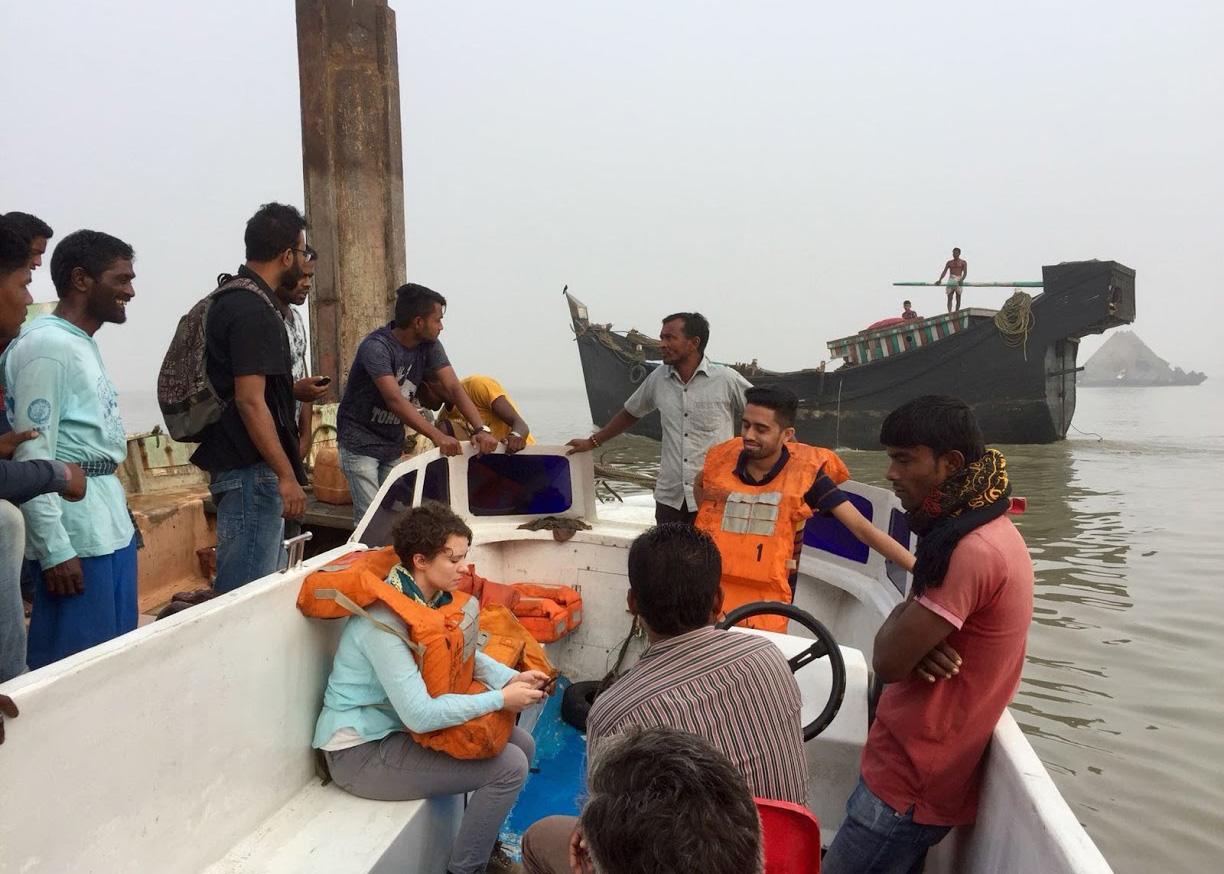
Safe crew transport in Bangladesh is not limited to road vehicles. On some corridors, road travel is inferior to electric intercity trains in both reliability and arrival precision — for example, Dhaka–Chattogram and Dhaka–Sylhet corridors can at times move faster by rail when roads clog. In deltaic regions, ferries and shallow-draft boats are not exceptions but built-in transport layers; ignoring them during planning guarantees friction later.
On certain long hauls with fixed call-times, crews may combine modes — e.g., rail for the long leg, then pre-positioned vehicles for final last-mile access. Buses are rarely used for film units due to control and timing limitations. Still, overnight executive coaches are occasionally utilized for lean research or pre-recce teams when cost efficiency outweighs flexibility. The correct mode is therefore context-specific: highway for speed, ferry for inevitability, rail for reliability, and hybrid routing when control and timing carry higher value than singular convenience.
Frequently Asked Questions (FAQ)
Yes, when properly planned. Safe transport requires vetted drivers, full-day vehicle holds, call-times that avoid congestion, and contingency routing. Risk comes from improvised planning, not the country itself.
MPVs (Toyota Noah/HiAce) for city shoots and recce days. SUVs (Pajero/Fortuner) for rural, coastal, or monsoon terrain. Covered pickups for heavy lighting and gear. Choice depends on crew size, terrain, and gear volume.
Not legally required, but essential for foreign crews. A fixer aligns vehicles, drivers, timing, and contingencies. Without one, crews typically lose 20–40% of shooting time to transport friction.
Technically yes, but strongly discouraged. Per-trip bookings risk drivers leaving mid-schedule for other jobs. Full-day holds cost slightly more but prevent stranded crews and lost daylight.
Between 03:30 and 05:00. The same 12 km route takes 25 minutes at 04:30 but over two hours after 08:00. A 30-minute delay costs 2–3 hours of lost shooting time.
Yes, but less than before. The Padma Bridge has eliminated major ferry delays on the central corridor. Secondary crossings on the Meghna River can still add 30 minutes to 3 hours.
Conclusion
Safe film crew transport in Bangladesh is not solved by renting a vehicle—it is solved by designing time, terrain, drivers, and contingencies around the way film work behaves in this country. When routes are checked, departures are disciplined, vehicles are held, and decisions are made by someone who understands both the story and the road. Travel stops are no longer a risk and become an enabler of the shoot.
Productions that treat transport as a mere logistical checkbox consistently lose shooting days to preventable failures: wrong departure times, unsuitable vehicles, drivers unfamiliar with production needs, or missing contingency plans when the primary route fails. By contrast, crews that invest in safe film crew transport in Bangladesh through proper planning gain schedule reliability, gear protection, and the flexibility to adapt when editorial or environmental conditions shift mid-shoot.
If you need fixer-led transport or end-to-end production logistics in Bangladesh, you may get in touch to discuss your route plan and schedule requirements.
