The commissioning maths has shifted. Budgets are tighter, turnarounds are shorter, visas are slower, and broadcasters now have to report the carbon cost of every long-haul flight they sign off. In 2026, the question isn’t whether to send a four-person crew from London or New York to Dhaka — it’s whether you need to send anyone at all. Remote filming in Bangladesh has moved from a pandemic-era workaround to a default execution model for news, current affairs, and documentary commissions that don’t need the director physically on set. This guide walks through what the model looks like, the technology behind it, where it succeeds and fails, and how to scope a shoot with us.
Key Takeaways
Five things to remember when scoping a remote shoot in Bangladesh in 2026.
- Remote filming in Bangladesh removes long-haul flights — the single largest carbon line item — while keeping editorial control with the foreign director.
- The model excels for interview-led, observational, news, and sensitive-access stories, and is the wrong call for presenter-led travelogues.
- The tech stack splits cleanly into live transmission (LiveU, Teradek, Haivision) and review-and-delivery (Frame.io, Aspera, MASV).
- Cost savings against flying a full foreign crew typically land in the 40–70% range, depending on shoot scope and duration.
- Nree delivers offshore film production Bangladesh commissions for the BBC, Channel 4, NatGeo, Al Jazeera, Sky News, Bloomberg, and The Economist — combining documentary editorial judgement with broadcast-grade execution.
Remote Filming Scenarios — Best Fit
- Interview-led documentary — single talent, controlled location, director on a return feed.
- Observational and vérité shoots — local crew earns trust the foreign crew never would in a one-week window.
- Breaking news packages — 24–72 hour turnarounds where flying a crew in is structurally impossible.
- Branded content with tight turnaround — agency reviews dailies, signs off, post is delivered remotely.
- Low-bandwidth field locations — bonded cellular and proxy workflows keep production moving on patchy 4G.
- Carbon and ESG-sensitive commissions — fully remote shoots dramatically reduce a production’s reportable footprint.
- Follow-up and pick-up shoots — additional material after a foreign crew has filmed the main block.
- Sensitive-access stories — sources who would never sit with a foreign crew will sit with a local DOP and producer.
What Remote Filming in Bangladesh Actually Means
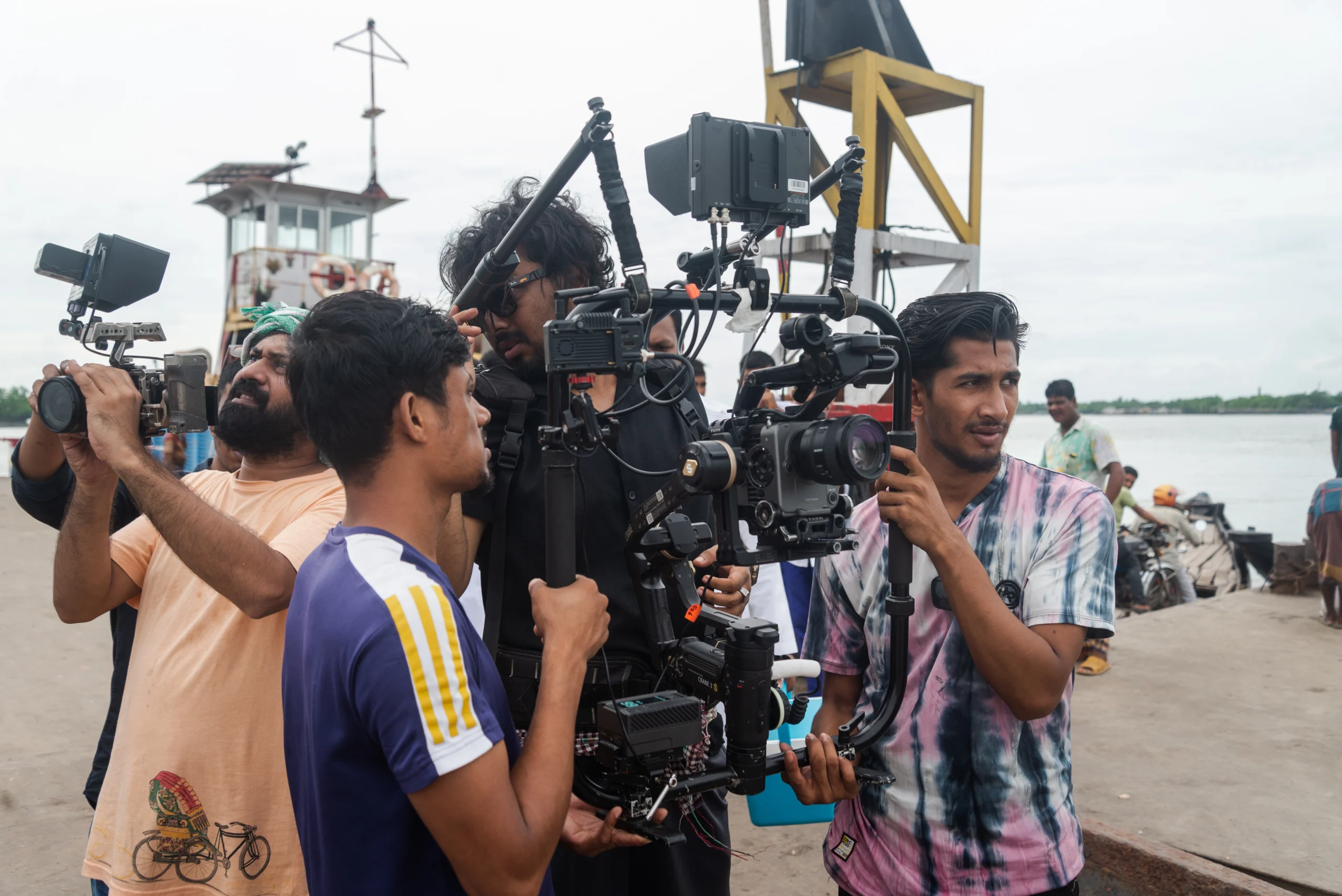
Remote filming in Bangladesh means a fully local crew on the ground, directed live or asynchronously by a foreign producer, with rushes delivered into the broadcaster’s post pipeline without anyone flying.
In practice, a remote production Bangladesh shoot has three moving parts: a Bangladeshi crew physically running cameras, sound, and lights; a director or producer in London, Doha, or New York giving creative direction via live IP video; and a delivery layer that moves dailies into the commissioner’s editorial workflow within hours. It’s not a fixer with a phone. It’s a directed shoot where the director’s chair happens to be 8,000 kilometres from the set. For many assignments we run out of Dhaka, the foreign team only sees the location through the lens — and the cut still lands on broadcast schedule.
Remote, hybrid, and “fixer-plus”
Three execution models get bundled as “remote.” A pure remote shoot sends nobody. A hybrid shoot sends one producer or correspondent who works alongside a local DOP, sound recordist, and line producer. A fixer-plus model commissions specific sequences the foreign team reviews from abroad. Each carries different cost, risk, and editorial-control trade-offs. Most of our 2026 enquiries land on hybrid for documentary and pure remote for news.
The End-to-End Remote Filming Workflow
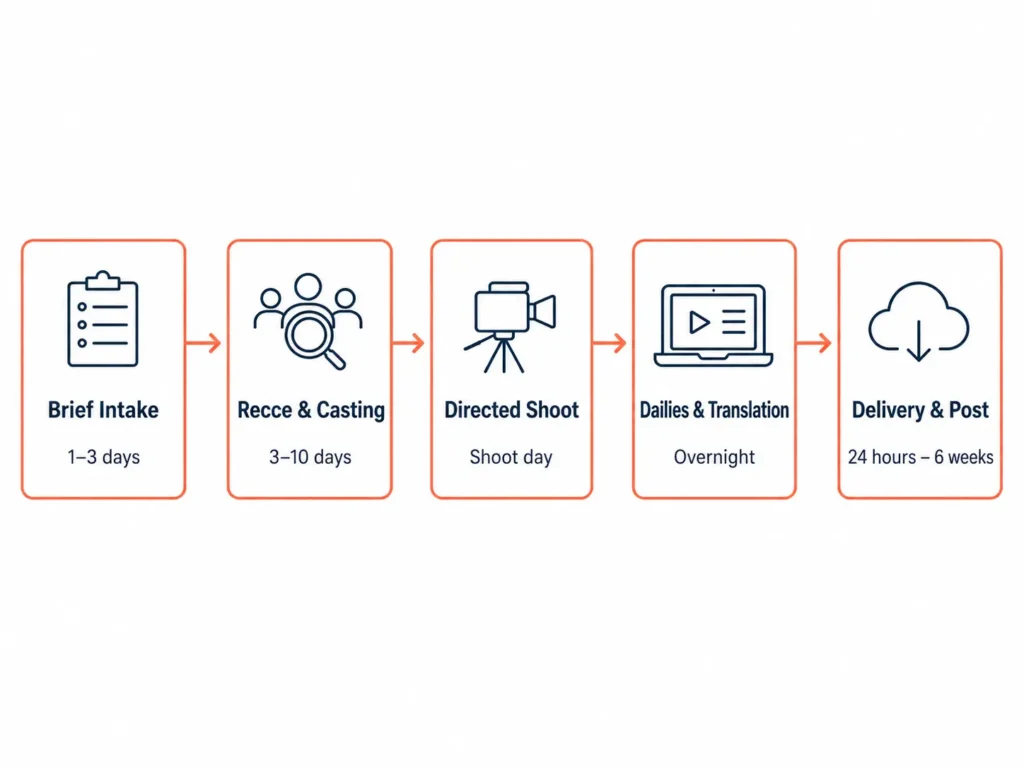
A directed remote shoot follows five stages — intake, recce, live-directed shoot, dailies, delivery — and the chain compresses to seventy-two hours when news demands it.
For complex commissions, the same workflow expands across weeks rather than days. Here’s how it runs:
- Brief intake and scoping (1–3 days). We take the editorial brief, confirm deliverable specs (codec, frame rate, aspect ratio, audio), and return a shot list, crew sheet, kit list, and fixed quote. For sensitive stories we also flag access risks and permit dependencies — see our filming permits in Bangladesh breakdown.
- Recce, casting, and access (3–10 days). Our team scouts locations, captures reference stills and video, casts contributors, and runs pre-interviews. The foreign producer reviews everything on Frame.io before signing off the shoot day.
- Live-directed shoot day. The crew works to the agreed shot list while the director monitors a live return feed via LiveU, Teradek, or Haivision. Cues come through an IFB or a comms app; framing, performance, and follow-ups happen in real time. More on the on-the-ground side in our guide to hiring local crew in Bangladesh.
- Dailies, transcripts, and translation (overnight). Rushes are backed up by a remote DIT, proxies are generated, transcripts and English subtitles are produced for Bangla interviews, and the package is uploaded to be waiting in the morning London time.
- Delivery and post (24 hours – 6 weeks). Final masters, EDLs, and project files transfer via Aspera, MASV, or Signiant. To keep post with us, our documentary video editing workflow shows how it runs.
Total turnaround for a single-day news shoot, brief to broadcast-ready: 48–72 hours. For a feature documentary block, expect 3–6 weeks pre to picture-lock-ready rushes.
Where Remote Filming Works — and Where It Doesn’t
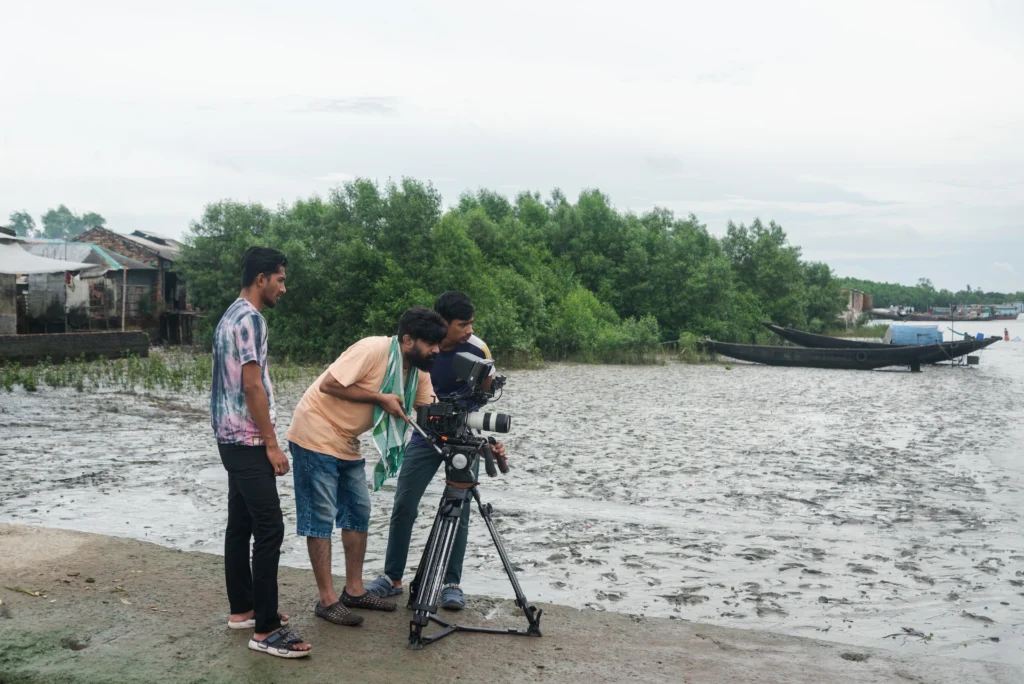
Remote filming in Bangladesh works brilliantly for interview-led, observational, and access-sensitive stories — and struggles when the director’s physical presence is itself part of the editorial.
Honesty matters here. We turn down briefs that won’t work as often as we accept ones that will. The model excels at sit-down interviews, fixed-rig observational work, walk-and-talks, archive-led pieces with new b-roll, and breaking news. It also excels at sensitive-access stories — climate-displaced communities in the Sundarbans, garment-sector reporting, Rohingya camp work — where a Bangladeshi crew with the right contacts gets in where a parachuted-in foreign crew never would.
Where it struggles: presenter-led travelogues where the foreign correspondent is the on-screen anchor; high-stakes adversarial interviews where the director’s read of the room matters; and large multicam set-pieces where on-the-ground producing can’t fall to a single line producer. For those, the hybrid model usually wins.
The honest failure points
Three things go wrong on remote shoots, and we plan for all three. 4G dropouts during live transmission — mitigated with bonded cellular, on-board recording as a hot backup, and a no-feed contingency agreed in advance. Time-zone friction on dailies approval — a 09:00 GMT review is 15:00 in Dhaka, fine; an evening UK review means overnight chasing of notes. We build the review cadence into the schedule. Latency in director cues — even 2–3 seconds is too long for fast follow-up questions, so we use IFB earpieces on a dedicated low-latency audio path, not video, for live direction.
Why International Broadcasters Choose Nree Production for Remote Filming in Bangladesh
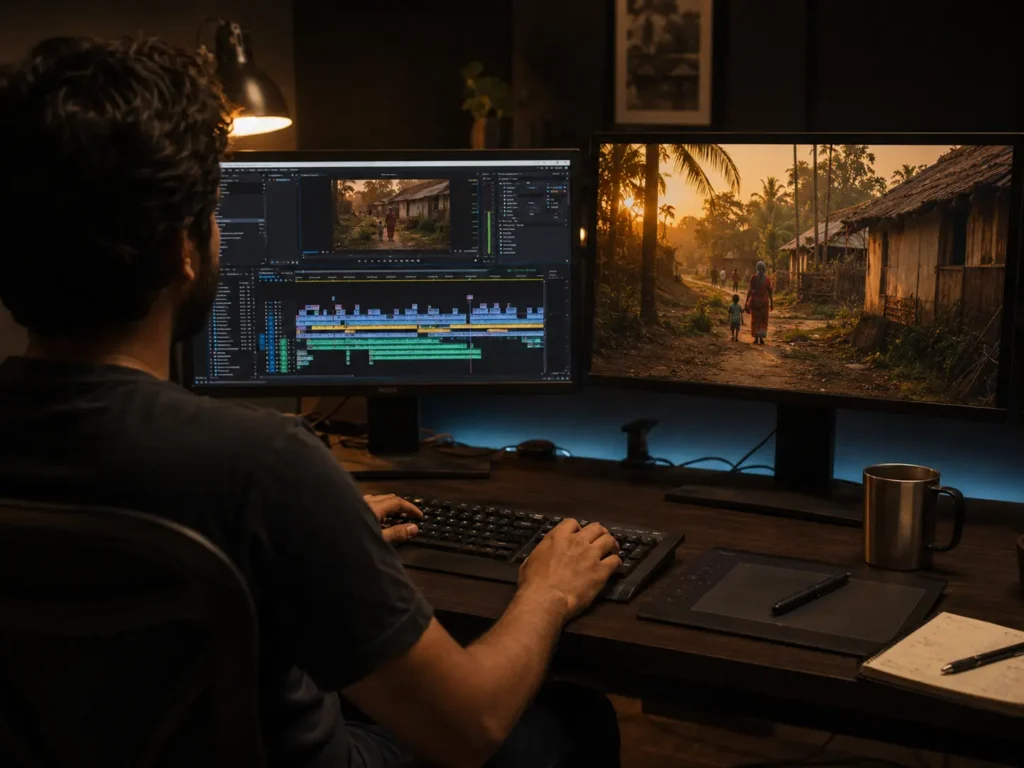
Nree Production pairs a working documentary journalist’s editorial instinct with the technical execution broadcasters need — and we deliver offshore film production in Bangladesh on commission for the BBC, Channel 4, NatGeo, Al Jazeera, Sky News, Bloomberg, and The Economist.
What we offer isn’t a fixer-with-extra-steps. It’s a directed production unit. Our founder is a DW Earth Journalism Network fellow and an Oxford Climate Journalism Network member, so editorial judgement on environmental, social, and political stories is in-house. Our DOPs and sound recordists work to international codec, framing, and delivery standards. We hold standing permit relationships — see our filming in Bangladesh guide — and we run our own drone operations under the relevant clearances.
The carbon argument is no longer abstract. BAFTA albert’s Accelerate 2025 report found that travel and transport account for 65% of the UK screen industry’s measured carbon footprint, with air travel alone making up almost a third (wearealbert.org). For a London-based commissioner, a remote shoot in Dhaka removes the single largest emissions line item from the production’s footprint — and the equivalent procurement-policy headache.
On the commercial side, our video editing rates breakdown shows how offshore execution shifts the maths beyond just travel cost. To keep the edit with us too, our outsourced video editing workflow explains the hand-off without losing creative control. For heavy rushes, see our note on transferring large video files for editing.
As Bangladesh’s premier production partner, Nree Production provides expert remote filming support for journalists, documentaries, and global media outlets. Contact Nree Production For Remote Filming Service in Bangladesh
The Tech Stack for Remote Video Shoot in Bangladesh
A robust remote stack combines bonded cellular for live transmission, Frame.io for review, and an enterprise file-transfer platform for heavy rushes.
The stack splits into two distinct layers. Live transmission keeps the director on set. Review and delivery move the actual rushes. You need both — conflating them is the single most common cause of remote shoots going wrong.
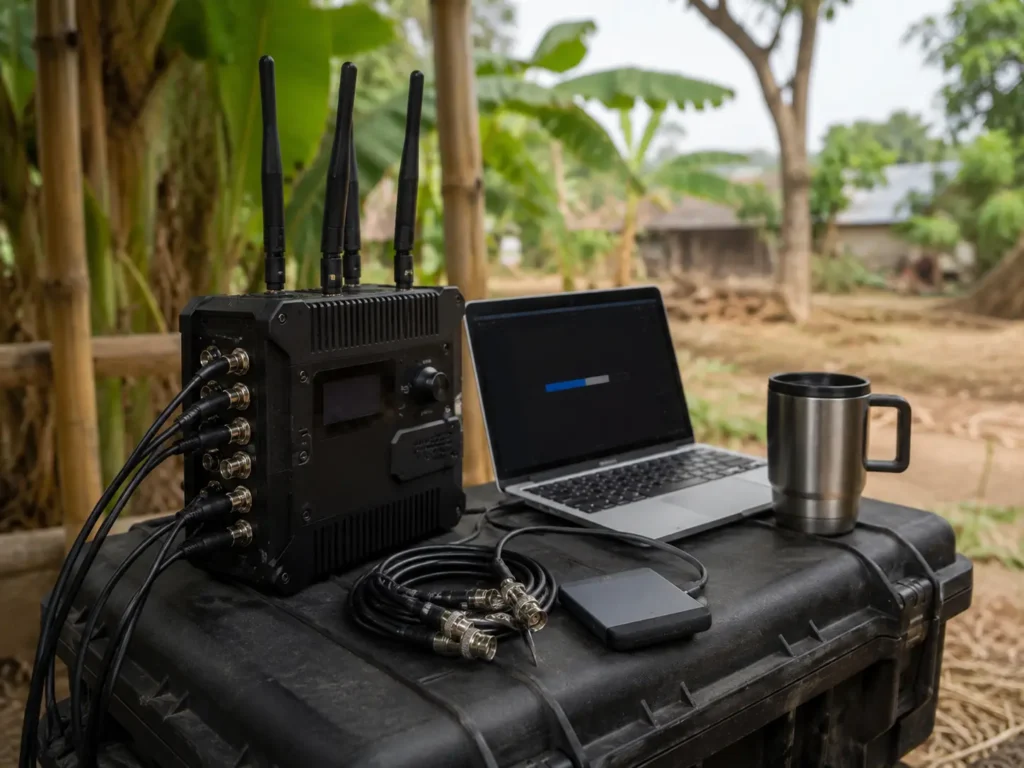
Live transmission and direction
LiveU
- Best for: broadcast-grade live feeds where reliability is non-negotiable.
- Pros: bonded cellular aggregates multiple carrier SIMs; proven in news; SRT and HEVC support.
- Cons: premium pricing; hardware logistics; high power draw on field shoots.
- Bandwidth and latency: sub-second to a few seconds depending on encoder mode; works on one stable cellular bearer.
- Security notes: AES encryption, dedicated cloud or on-prem reception.
- Pricing model: subscription plus data; varies by region and plan tier.
- Ideal use case: live director feed from a Rohingya camp shoot where signal is unpredictable.
- Setup difficulty: medium — needs a trained operator.
Teradek
- Best for: monitoring, remote DIT, and director return feeds.
- Pros: strong ecosystem (Bolt, Serv, Prism); excellent Frame.io camera-to-cloud integration; flexible price points.
- Cons: Some setups need wired infrastructure; bonded options exist but aren’t always the default.
- Bandwidth and latency: glass-to-glass latency can hit sub-100ms on Bolt RF; cloud paths add seconds.
- Security notes: AES-256 on supported devices.
- Pricing model: hardware purchase plus optional service tiers.
- Ideal use case: controlled interviews where the director wants near-zero latency framing review.
- Setup difficulty: medium.
Haivision
- Best for: broadcast and corporate live IP video.
- Pros: invented the SRT protocol; enterprise-grade reliability; strong codec support including HEVC.
- Cons: more common in studio and stadium environments than run-and-gun documentary.
- Bandwidth and latency: SRT tunes latency against packet loss; typically 0.5–3 seconds.
- Security notes: AES-128/256, end-to-end SRT.
- Pricing model: hardware plus Makito/Pro service tiers.
- Ideal use case: multi-camera live events being directed from abroad.
- Setup difficulty: medium to high.
Review, dailies, and delivery
Frame.io
- Best for: asynchronous director review, frame-accurate notes, version control.
- Pros: industry-standard for review and approval; camera-to-cloud with supported hardware; tight Premiere and Resolve integration.
- Cons: consumer plans cap storage; very large rushes need enterprise tiers.
- Bandwidth and latency: proxy uploads run on modest connections; full-res needs serious bandwidth.
- Security notes: SOC 2, role-based access, watermarking.
- Pricing model: subscription tiers; varies by seats and storage.
- Ideal use case: London director reviewing at 09:00 GMT what Dhaka shot the previous afternoon.
- Setup difficulty: low.
Aspera (IBM)
- Best for: enterprise transfer of very large files at near line-rate speeds.
- Pros: FASP protocol bypasses TCP bottlenecks; broadcaster standard; resilient on lossy networks.
- Cons: enterprise pricing; needs IT setup at the receiving end.
- Bandwidth and latency: scales close to the available pipe; built for 100GB+ daily rushes.
- Security notes: AES-128 on the wire and at rest.
- Pricing model: enterprise contracts; varies considerably by region.
- Ideal use case: delivering a 200GB shoot day overnight into a broadcaster’s MAM.
- Setup difficulty: high on first setup, low thereafter.
MASV
- Best for: ad-hoc large-file transfer without enterprise contracts.
- Pros: pay-as-you-go option; very fast; no per-file size limit; simple UX.
- Cons: per-GB pricing can add up across a long shoot block.
- Bandwidth and latency: accelerated network; materially outperforms WeTransfer-tier services.
- Security notes: AES-256, TLS in transit, regional storage options.
- Pricing model: per-GB or subscription; check current plans for region.
- Ideal use case: sending 80GB of dailies to a producer who doesn’t have Aspera.
- Setup difficulty: very low.
A quick decision framework
- If you need a live director feed during interviews → bonded cellular (LiveU or Teradek).
- If the director can review asynchronously → Frame.io with daily proxy uploads.
- If you’re moving 100GB+ rushes per day → Aspera or MASV, not consumer cloud.
- If the field location has weak 4G → on-board recording plus a hard-drive courier and overnight proxy upload.
- If the broadcaster has strict ESG reporting → fully remote with a carbon estimate provided up front.
FAQs
How much does remote filming in Bangladesh cost compared to sending a foreign crew?
Typically 40–70% less than flying a full crew from the UK, EU, or US. Savings come from removed flights, accommodation, per diems, excess-baggage kit fees, plus lower local crew rates. Exact figures depend on shoot length, kit specs, and locations. Request a scoping call for a fixed quote.
How do you handle creative direction when the director isn’t on set?
In practice, by the time we’re filming, the director’s vision is already in our hands. We run detailed pre-production — briefs, recces, casting, shot-list sign-offs — so the editorial frame is locked before the crew leaves for shooting. During the shoot itself, time-zone gaps make sustained live connection impractical for most international commissions. We keep the director in the loop via WhatsApp calls and reference photos from the ground, and a fuller dailies review happens after wrap. What makes the model work is track record: enough delivered commissions with the BBC, Channel 4, NatGeo, OpenPlanet, and Al Jazeera that briefing us is closer to briefing a unit than briefing a fixer.
What internet and live-streaming infrastructure do you use in Bangladesh?
Honestly, Bangladesh’s live transmission infrastructure isn’t broadcast-grade — bonded cellular at the reliability UK or US news crews expect isn’t a realistic default here. What is reliable is broadband, particularly in Dhaka and other urban hubs, which lets us push rushes out fast after the shoot ends. For commissions that genuinely need a live feed, we can spec a bonded cellular rig in for the shoot — but that’s the exception, not the standard workflow.
Can sensitive or restricted-access shoots be handled remotely?
Often more effectively than with a foreign crew. Local DOPs and producers carry trust and language access that parachute crews can’t replicate quickly, particularly for climate-displaced communities, marginalised groups, and stories where a foreign presence would change the scene. We assess access risk during scoping.
How quickly can a remote shoot be turned around?
For news packages, 48–72 hours from brief to broadcast-ready master is realistic on accessible stories. For documentary commissions, expect 3–6 weeks pre-production-to-rushes for a single shoot block. Permits, contributor access, and approval cycles drive the timeline more than the filming itself.
Is remote filming suitable for high-end documentary, or only news packages?
Both. We deliver cinema-grade documentary work remotely using the camera packages a foreign DOP would bring — Sony Venice 2, FX9, FX6, RED, ARRI — with full-resolution masters delivered downstream. The remote model is about workflow, not a step down in production value.
How does remote filming reduce a production’s carbon footprint?
By removing the biggest emissions line item in international productions: long-haul flights and onward transport for foreign crew. With travel making up almost two-thirds of the UK screen industry’s footprint, switching to a remote model is the single most effective carbon-reduction lever available to a commissioning editor.
Conclusion
The commissioning reality we opened with — tighter budgets, ESG scrutiny, slower visas, faster turnarounds — isn’t going to ease in 2026. Remote filming in Bangladesh isn’t the only answer, but for the right brief it’s the better one: lower cost, lower carbon, and frequently better access than a parachuted-in crew can deliver. If you’re scoping a documentary, news, or branded shoot in Bangladesh, get in touch for a no-commitment scoping call. We’ll come back with a shot list, crew sheet, kit list, and fixed quote — usually within 48 hours.
You may also like our guide on Full Service Video Production in Bangladesh
